In small workshops, lifting heavy molds, machine parts, and tools often becomes challenging due to limited space and frequent workstation changes. A portable jib crane offers a compact, flexible, and cost-effective lifting solution. In this guide, we will help you choose the best portable jib cranes for small workshops by comparing load capacity, boom reach, mobility, installation requirements, and budget considerations.
Table of Contents
- 1 What Is Best Portable Jib Cranes for Small Workshops?
- 2 Why Small Workshops Need Portable Jib Cranes
- 3 Best Portable Jib Crane Types for Small Workshops
- 4 How to Choose the Best Portable Jib Crane?
- 5 Typical Applications in Small Workshops
- 6 Price Guide for Small Workshop Portable Jib Cranes
- 7 Conclusion
- 8 FAQ
- 8.1 1. What capacity is best for a small workshop?
- 8.2 2. Can a portable jib crane be moved easily?
- 8.3 3. Does it need floor anchoring?
- 8.4 4. What is the typical price?
- 8.5 5. Is electric hoist included?
- 8.6 6. Can it be customized for mold handling?
- 8.7 7. Is it suitable for multiple workstations?
What Is Best Portable Jib Cranes for Small Workshops?
A portable jib crane for small workshops is a compact and flexible lifting solution designed to handle materials, tools, molds, and machine parts in limited workspaces. Unlike fixed cranes, it can be easily moved to different workstations, making it ideal for workshops where lifting tasks occur in multiple areas.
This type of jib crane is widely used in automotive repair shops, mold manufacturing, equipment maintenance, and light industrial production, helping improve handling efficiency while reducing manual labor and safety risks. For small businesses looking for a cost-effective and space-saving lifting system, a portable jib crane offers excellent flexibility, easy installation, and a strong return on investment.

Components of Portable Jib Crane
The key components of a portable jib crane typically include a vertical mast, which provides stable structural support, a rotating jib arm that allows smooth horizontal movement of loads, and an electric chain hoist for efficient lifting and lowering operations. Most models also feature a mobile base with heavy-duty casters, enabling easy relocation within the workshop. One of the main reasons it fits small spaces is its small footprint, which minimizes floor occupation while maintaining lifting capacity.
It has flexible positioning allows operators to move the crane exactly where lifting is needed, making it highly suitable for dynamic work environments. In addition, it requires no overhead rail or ceiling-mounted system, eliminating complex structural modifications and reducing installation costs. This makes portable jib cranes an ideal choice for workshops with limited floor space and changing operational needs.
Why Small Workshops Need Portable Jib Cranes
For small workshops, improving lifting efficiency while making the best use of limited space is often a top priority. Traditional lifting equipment, such as fixed cranes or forklifts, may take up too much room or lack the flexibility required for daily operations. A portable jib crane offers a practical solution by combining compact design, easy movement, and efficient lifting performance. It helps small workshops handle tools, molds, spare parts, and equipment safely and efficiently, while reducing operational costs and improving workflow flexibility.
Limited Floor Space
One of the biggest concerns for workshop buyers is how to maximize limited floor space. Portable jib cranes are designed with a small footprint, allowing them to fit into narrow production areas, maintenance bays, or assembly corners without disrupting normal operations. Since they do not require overhead rails or permanent installation, they are ideal for workshops with space constraints.
Frequent Material Handling
Small workshops often need to lift and move materials many times throughout the day. Frequent manual handling can slow down production and increase the risk of workplace injuries. A portable jib crane provides fast and reliable lifting support, making repetitive tasks such as loading machine parts, moving molds, or transferring components much easier and more efficient.
Flexible Workstation Movement
Buyers also often ask whether the lifting equipment can adapt to changing workstations. With a mobile base and casters, portable jib cranes can be easily moved between different areas, making them highly suitable for flexible production layouts and multi-station workshops.
Reduce Manual Labor Costs
Another major pain point is labor cost. By reducing dependence on manual lifting and minimizing operator fatigue, portable jib cranes help workshops lower labor costs, improve safety, and increase overall productivity.
Best Portable Jib Crane Types for Small Workshops
Choosing the best portable jib crane for a small workshop depends largely on the workspace layout, lifting frequency, and material handling requirements. Buyers often focus on questions such as which type saves the most space, which is easiest to move, and which fits complex workstations. Different crane types are designed for different workshop conditions, so selecting the right solution can significantly improve efficiency, safety, and return on investment.
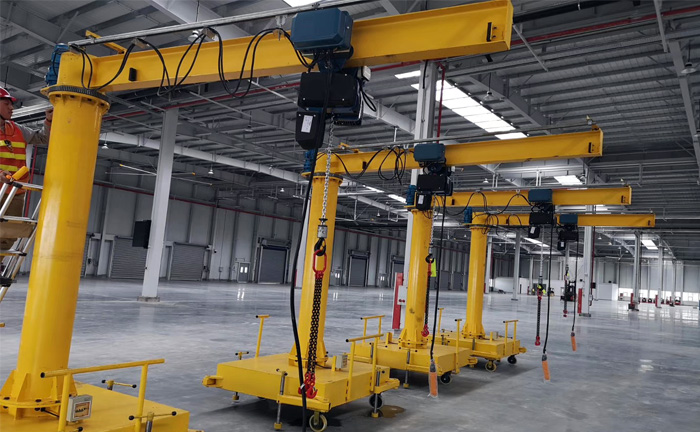
Mobile Base Portable Jib Crane
The mobile base portable jib crane is one of the most popular choices for small workshops because of its excellent flexibility. It is widely used in mold workshops, injection molding factories, and maintenance shops, where lifting points change frequently. Equipped with heavy-duty casters or a movable base, this type can be repositioned easily between workstations, making it ideal for dynamic production environments.
- Lifting capacity: 250 kg–1,000 kg
- Arm length: 2–4 m
- Rotation angle: 270°–360°
- Lifting height: 2–4 m

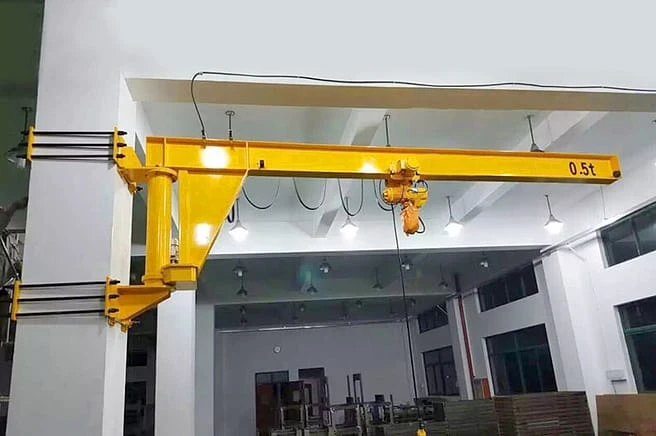
Wall-Mounted Compact Jib Crane
For workshops with extremely limited floor space, a wall-mounted compact jib crane is an excellent solution. It is fixed directly to a wall or structural column, eliminating the need for a floor base and maximizing usable workspace. This design is especially suitable for compact assembly areas and small repair stations.
- Lifting capacity: 125 kg–500 kg
- Arm length: 1–3 m
- Rotation angle: 180°–200°
- Installation type: wall or column mounted

Articulating Jib Crane
An articulating jib crane is best for workstations with multiple obstacles, machines, or tight corners. Its multi-joint arm design allows flexible movement around equipment, making it ideal for precise handling tasks in crowded work areas.
- Lifting capacity: 80 kg–500 kg
- Arm reach: 2–5 m
- Rotation angle: up to 360°
- Joint sections: 2-arm articulated design

How to Choose the Best Portable Jib Crane?
Choosing the best portable jib crane for a small workshop is not only about price, but also about matching the crane to your actual lifting tasks, workspace layout, and future production needs. Buyers typically focus on load capacity, working radius, movement flexibility, and installation convenience. A well-matched crane can improve handling efficiency by 30–50% while reducing manual labor and downtime. For most small workshops, the most commonly selected range is 0.5–2 ton, which offers a strong balance between capacity and mobility.
Lifting Capacity
The first factor to consider is the lifting capacity. Common options include 250 kg, 500 kg, 1000 kg, and 2000 kg. For mold shops, injection molding factories, and maintenance workshops, 500 kg to 2 ton is the most frequently used range. Always choose a model with at least 20–30% extra capacity margin to ensure safe long-term operation.
Boom Length and Reach
The boom length and reach determine the working coverage of the crane. Standard lengths are typically 2 m, 3 m, and 4 m, while customized lengths are available for special workstations. Longer reach improves flexibility but should be balanced with load requirements and floor space.
Rotation Angle
The rotation angle affects how widely the crane can serve the workspace. Common options include 180°, 270°, and 360° rotation. For central workstations or flexible workshops, 360° rotation is often preferred for maximum coverage.
Mobility Design
Mobility is a major concern for buyers. Key design options include caster wheels for manual movement, forklift pockets for easy relocation, and electric drive movement for frequent position changes in larger workshops.
Installation Requirements
A major advantage of portable jib cranes is that many models require no foundation or permanent floor fixing, which reduces installation time and cost and makes them ideal for rental workshops or changing production layouts.
Typical Applications in Small Workshops
Portable jib cranes are widely used in small workshops that require frequent lifting, precise positioning, and flexible workstation movement. For buyers, real application scenarios are often one of the most important factors when evaluating equipment suitability. In compact production environments, this type of crane helps improve workflow efficiency, reduce manual handling risks, and support multi-station operations.
Mold Handling
Mold handling is one of the most common applications in small workshops. Portable jib cranes are widely used for lifting, transferring, and positioning injection molds, stamping dies, and tooling components between storage racks, CNC machines, and molding equipment. For mold shops, the typical load range is 500 kg to 2 tons, making portable jib cranes an ideal solution for safe and efficient mold change operations.
CNC Machine Loading
Another common application is loading and unloading CNC machine parts. In machining workshops, operators often need to move heavy workpieces, fixtures, or metal components between processing stations. A portable jib crane allows fast and accurate positioning, helping reduce machine downtime and improve production efficiency.
Assembly Line Component Transfer
Portable jib cranes are also widely used for component transfer along small assembly lines. They are suitable for moving motors, metal frames, pump parts, or mechanical assemblies between adjacent workstations. Their flexible mobility makes them ideal for workshops with changing layouts or multiple production cells.
Price Guide for Small Workshop Portable Jib Cranes
The price of a portable jib crane for small workshops mainly depends on lifting capacity, boom length, rotation angle, mobility design, and hoist type. For most small workshops, standard models typically fall between $1,200 and $4,500, while customized solutions are usually quote-based. Factors such as electric drive movement, extended boom reach, and custom lifting height may increase the final price. The table below provides a general reference for common workshop applications.
| Capacity | Typical Application | Price Range (USD) |
|---|---|---|
| 250 kg | Tooling transfer, light mold handling, maintenance shop | $1,200–$2,000 |
| 500 kg | Injection molding workshop, CNC loading, die transfer | $1,800–$3,000 |
| 1 ton | Mold workshop, machine repair, automotive components | $2,500–$4,500 |
| Custom Model | Special reach, height, electric movement, heavy-duty use | Quote-based |
For small workshops, the 500 kg to 1 ton range is usually the most cost-effective choice, offering a good balance between lifting performance and mobility. If your application involves frequent mold changes or multi-station movement, a customized portable jib crane may provide better long-term value and lower labor costs.
Conclusion
Choosing the right portable jib crane for a small workshop can significantly improve material handling efficiency, reduce manual labor costs, and make better use of limited floor space. From lifting capacity and boom reach to mobility design and application scenarios, selecting the right model depends on your specific workshop layout and daily lifting needs. Whether you need a standard 250 kg–1 ton solution or a fully customized crane for mold handling and multi-station operations, the right equipment can deliver long-term productivity and safety benefits.
If you are looking for the best portable jib crane solution for your workshop, our experienced team is here to help. Contact us today for expert advice, customized recommendations, and a fast quotation based on your application requirements.
FAQ
1. What capacity is best for a small workshop?
For most small workshops, 500 kg to 1 ton is the most common choice. Mold shops and injection factories typically prefer 0.5–2 ton models for safe daily lifting.
2. Can a portable jib crane be moved easily?
Yes. Most models come with heavy-duty caster wheels, forklift pockets, or optional electric drive movement, allowing easy relocation between different workstations.
3. Does it need floor anchoring?
In most cases, no floor anchoring is required. Portable jib cranes are designed with a stable mobile base, making them ideal for workshops that need flexible positioning.
4. What is the typical price?
Typical prices range from $1,200 to $4,500, depending on capacity and configuration. Customized models for mold handling are usually quote-based.
5. Is electric hoist included?
Yes, many standard models include an electric chain hoist. Common lifting speeds are 3–8 m/min, depending on the load capacity and motor configuration.
6. Can it be customized for mold handling?
Absolutely. Portable jib cranes can be customized for mold weight, boom length, lifting height, and 360° rotation, especially for injection molding workshops.
7. Is it suitable for multiple workstations?
Yes. This is one of its biggest advantages. One crane can serve multiple machines or assembly stations, helping reduce equipment investment costs.




 English
  Español
  Português
  العربية
  Français
  Русский