
Selecting the correct jib crane capacity is a key step before purchase. Many buyers only consider the load weight, but actual capacity depends on several factors, including boom length, lifting attachments, working conditions, and required safety margin. An undersized crane can create safety risks and accelerate equipment wear, while an oversized one increases unnecessary costs. This guide explains how to choose the right capacity based on real working conditions, helping you make a practical and informed decision before ordering.
Why Load Capacity Matters
Load capacity is not just a specification on paper; it directly affects safety, structural design, and long-term operational cost. In real workshop environments, jib cranes are often used repeatedly throughout the day, and incorrect sizing can accelerate wear or create instability in the supporting structure.
In practice, most industrial users select a capacity with a 10%–20% safety margin above the maximum working load. This margin helps reduce stress on the boom, bearings, and anchoring system, especially in high-frequency lifting applications.
Key impacts of load capacity selection
- Affects the structural design of floor or wall mounting
- Determines anchor bolt size and foundation requirements
- Influences crane lifespan and maintenance cycle
- Impacts safety compliance and inspection results
In many engineering cases, undersized cranes fail earlier due to repeated overload conditions rather than single extreme loads. Slab thickness, anchor bolt grade, and concrete cure time all scale with the capacity you land on — the floor and wall structural requirements for each load range are detailed in this jib crane installation guide.
Understand Rated Capacity vs Working Load
Before selecting a jib crane, it is important to distinguish between rated capacity and actual working load. These two values are often confused during procurement, leading to incorrect selection.
Rated capacity refers to the maximum load the crane is designed to lift under ideal conditions. However, in real use, accessories, lifting height, and dynamic force all reduce the safe working range.

Comparison table
| Item | Description | Real Usage Impact |
|---|---|---|
| Rated Capacity | Maximum design load | Theoretical limit |
| Working Load | Actual daily lifting load | Includes accessories |
| Safe Working Load (SWL) | Recommended operating limit | 80–90% of rated load |
For example, a 1 ton jib crane is often used with an actual safe working load of around 800–900 kg in continuous operation environments.
Step 1: Calculate Actual Load Weight
The first step in capacity selection is determining the real maximum lifting weight in daily operations. Many users only consider the product weight, but this is not sufficient for engineering selection.
Load components to include:
- Workpiece or product weight
- Mold, fixture, or tooling
- Pallets or containers
- Handling equipment
Example calculation
| Component | Weight |
|---|---|
| Mold | 750 kg |
| Electric hoist | 60 kg |
| Lifting sling | 20 kg |
| Total load | 830 kg |
In this case, selecting a 1 ton jib crane is more appropriate than a 750 kg unit.
Industry practice shows that ignoring auxiliary equipment can lead to 5%–12% underestimation of total load.
Step 2: Include Hoist and Rigging Weight
Capacity selection must include all lifting accessories. This is one of the most common mistakes in procurement.
Even small components contribute to total load, especially in precision manufacturing or mold handling applications.
Typical accessory weights
| Accessory | Weight Range |
|---|---|
| Electric chain hoist | 50–120 kg |
| Wire rope sling | 10–30 kg |
| Hook block | 15–40 kg |
| Spreader beam | 30–150 kg |
In many industrial installations, accessories account for 5%–10% of total load.
Ignoring them can lead to repeated overload conditions during daily use.
Step 3: Consider Boom Length and Working Radius
Capacity is not independent of boom length. As the working radius increases, the bending moment on the structure increases significantly.
The relationship can be expressed as:
M=F×L
Where:
- M = bending moment
- F = load
- L = boom length
Practical example
| Load | Boom Length | Moment Load |
|---|---|---|
| 1000 kg | 3 m | 3000 kg·m |
| 1000 kg | 5 m | 5000 kg·m |
A 5-meter boom increases structural load by 66% compared to 3 meters, even if the lifting weight remains the same.
Engineering impact
- Longer boom requires stronger mast section
- Higher anchoring force needed
- Increased deflection control required
This is why identical rated cranes may have different structural requirements depending on span.
Step 4: Consider Duty Cycle and Working Frequency
Capacity selection is not only about static load but also about how often the crane is used. Continuous lifting operations generate heat, fatigue, and mechanical wear.
Typical usage classification
| Duty Level | Usage Frequency | Recommended Margin |
|---|---|---|
| Light | 2–10 lifts/day | +10% |
| Medium | 10–50 lifts/day | +15% |
| Heavy | 50+ lifts/day | +20% |
In production environments such as machining or assembly lines, cranes often operate in medium to heavy duty conditions, requiring a higher safety margin.
Frequent cycling increases stress on:
- Bearings
- Gear systems
- Structural joints
- Anchor bolts
Common Jib Crane Capacity Ranges
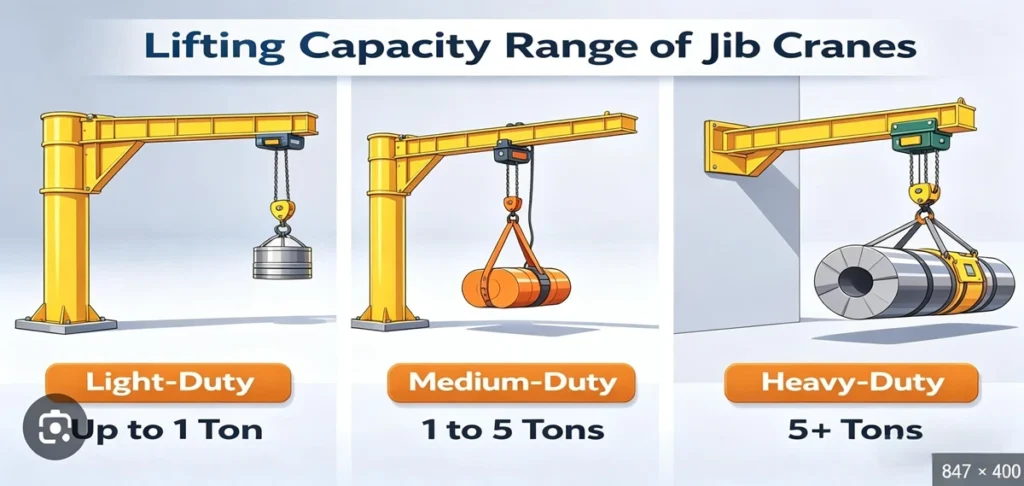
Common jib crane capacity ranges are typically selected based on the load type, working frequency, and application environment. In most industrial settings, standard capacities include 250–500 kg for light-duty assembly and workstation handling, 1 ton for machine loading and mold transfer, 2 ton for fabrication and maintenance work, and 3–5 ton for heavy manufacturing applications. Among these, 1 ton and 2 ton models are the most commonly used, as they offer a practical balance between lifting capability, installation cost, and daily workshop needs. Choosing the right range should always consider actual load weight, boom length, and a suitable safety margin.
| Capacity | Typical Application |
|---|---|
| 250–500 kg | Light assembly, workstation lifting |
| 1 ton | CNC machining, mold handling |
| 2 ton | Fabrication, maintenance workshops |
| 3–5 ton | Heavy manufacturing, steel handling |
Common Mistakes in Capacity Selection
Capacity selection mistakes are one of the most common reasons for reduced lifting efficiency, faster component wear, and avoidable replacement costs. In actual projects, many buyers focus only on the rated load shown in the catalog and overlook factors such as accessory weight, boom length, duty cycle, and future production growth. Industry experience shows that nearly 30% of selection issues come from underestimated actual load conditions, especially in workshops with frequent lifting tasks.
Common mistakes include:
- Selecting based only on product weight
Many buyers calculate only the workpiece weight and ignore the hoist, slings, hooks, and fixtures, which can add 5%–10% extra load. - No safety margin
Choosing a crane exactly equal to the load weight leaves no allowance for dynamic force. A 10%–20% safety margin is generally recommended. - Ignoring boom length and working radius
A 5 m boom can generate over 60% more bending moment than a 3 m boom under the same load, directly affecting capacity selection. - Overlooking lifting frequency
For cranes used 50+ lifts per shift, selecting a slightly higher capacity helps reduce wear on bearings and hoist components. - No allowance for future expansion
Many workshops increase lifting demand within 1–2 years, so reserving 15% additional capacity is often a practical long-term solution.
To better match the right load capacity with your application, you can also explore different types of jib cranes, such as floor-mounted, wall-mounted, portable, and articulating models, each designed for specific workspace and lifting requirements.
Conclusion
Choosing the right jib crane capacity involves more than simply matching the rated load to the product weight. For reliable long-term performance, buyers should also consider the total lifting load, hoist and rigging accessories, boom length, working radius, and daily lifting frequency. In real industrial applications, allowing a 10%–20% safety margin helps improve lifting stability, reduce component wear, and extend service life. In most workshop environments, selecting a capacity slightly above the actual working load is a more practical and cost-effective approach than operating at the limit. Voitto Crane can help evaluate your lifting requirements and recommend the most suitable jib crane solution for your project. Contact our team today for expert guidance and a fast quotation.

Alan
Crane Solutions Specialist · Voitto Crane
Specialized in Overhead Crane, Gantry Crane, Jib Crane, Port Crane & EOT Crane export solutions. 10+ years helping global clients with pre-sales consultation, capacity selection and site-specific configurations.
FAQs
What jib crane capacity is best for general workshop use?
For most workshops, 1 ton capacity is the most common choice. It covers typical loads like motors, molds, and machine parts while maintaining a safe margin for accessories and daily lifting operations.
How much safety margin should be considered when selecting capacity?
A 10%–20% safety margin is commonly recommended. This helps account for hoist weight, rigging, and dynamic lifting forces, ensuring the jib crane operates safely without constant load stress or premature wear.
Can I choose capacity based only on the product weight?
No. Product weight alone is not enough. You must also include hoist, slings, fixtures, and dynamic forces. Ignoring these factors often leads to undersized cranes and reduced safety during operation.
Does boom length affect jib crane capacity selection?
Yes. A longer boom increases bending moment and structural stress even with the same load. For example, a 5 m boom generates significantly higher torque than a 3 m boom, affecting capacity requirements.
What happens if I choose an undersized jib crane?
An undersized crane may cause overloading, excessive deflection, faster component wear, and potential safety risks. It can also increase maintenance costs and reduce the overall service life of the equipment.
Is it necessary to upgrade capacity for future use?
Yes, it is recommended to consider future production needs. Many facilities increase load requirements within 1–2 years, so selecting slightly higher capacity helps avoid costly upgrades or replacement later.


 English
  Español
  Português
  العربية
  Français
  Русский