
- 1 Understanding the 10 Ton Overhead Crane: What You’re Actually Buying
- 2 Types of 10 Ton Overhead Cranes: Which One Fits Your Operation?
- 3 What Drives 10 Ton Overhead Crane Cost?
- 4 What to Ask Your Supplier Before You Buy
- 5 Making the Final Decision: A Practical Checklist
-
6
FAQ: 10 Ton Overhead Crane
- 6.1 Q1: What is the difference between a 10 ton single girder and double girder overhead crane?
- 6.2 Q2: How much does a 10 ton overhead crane cost to install?
- 6.3 Q3: What certifications should a 10 ton bridge crane have?
- 6.4 Q4: How do I know if my building can support a 10 ton overhead crane?
- 6.5 Q5: What maintenance does a 10 ton overhead crane require?
Choosing a 10 ton overhead crane is not a small decision. It affects daily operations, worker safety, and your facility’s long-term productivity. Yet many buyers rush the process — and end up with a crane that doesn’t fit their layout, duty cycle, or budget.
This guide cuts through the confusion. Whether you’re comparing a 10 ton bridge crane for a new workshop or replacing aging equipment, you’ll find the practical information you need. We cover the key specs, the main crane types, what drives 10 ton overhead crane cost, and the questions you must ask before signing any purchase order.
No jargon overload. No vague recommendations. Just the facts that help you decide.
Understanding the 10 Ton Overhead Crane: What You’re Actually Buying
What “10 Ton” Really Means
The rated capacity of 10 tons (approximately 10,000 kg) tells you the maximum load of 10 ton bridge crane is designed to lift safely. But capacity alone does not tell the whole story.
A crane’s safe working load (SWL) must account for the weight of the hook block, lifting attachments, and any rigging hardware. In practice, your usable lifting capacity may be 9.5 tons or less after accounting for these components. Always confirm net capacity with your supplier — not just the headline number.
Capacity is governed by standards such as ISO 4301 (crane classification) and FEM 1.001 (European design rules), which define how a crane must perform across its rated service life.
Span, Headroom, and Hook Height: The Three Numbers That Matter Most
Before selecting any 10 ton bridge crane, you need three measurements from your facility:
| Parameter | What It Means | Why It Matters |
|---|---|---|
| Span | Distance between runway rails | Determines crane width; affects structural cost |
| Hook Height (Lift Height) | Max vertical distance hook can travel | Limits how high you can lift a load |
| Headroom | Space between the hook and ceiling | Impacts whether a standard or low-headroom hoist fits |
Many buyers focus on capacity and overlook headroom. A standard double-girder crane needs more vertical clearance than a low-headroom design. If your facility has tight ceiling space, this single factor can eliminate certain crane configurations entirely.
Types of 10 Ton Overhead Cranes: Which One Fits Your Operation?
Single Girder vs. Double Girder


This is the most common question buyers face. Here’s a straightforward comparison:
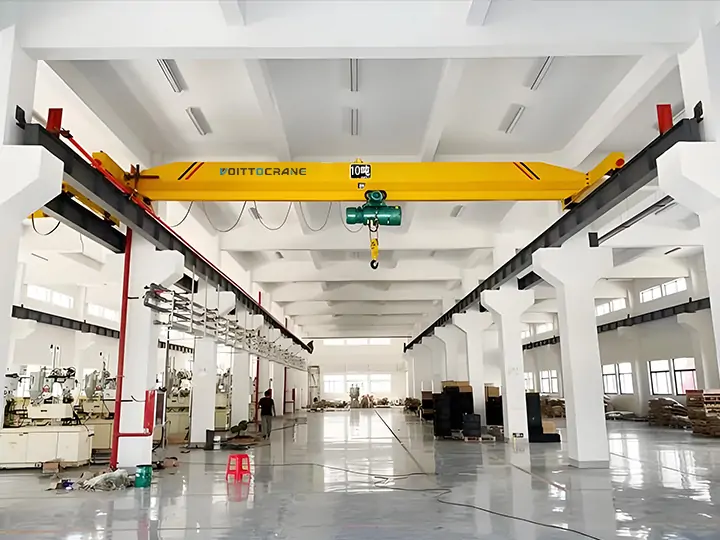
Single girder cranes use one main beam. They are lighter, less expensive to install, and work well for moderate duty cycles. For a 10 ton capacity, single girder designs are feasible but require careful structural calculation.
Double girder cranes use two parallel beams. They provide greater rigidity, higher hook heights (since the hoist sits on top of the girders rather than beneath), and are better suited for heavy-duty or continuous-use environments.
For most light-to-medium industrial applications — machine shops, assembly lines, warehousing — a single girder 10 ton crane is sufficient. If you’re running multiple shifts or lifting frequently throughout the day, step up to double girder.
Top-Running vs. Underhung


Top-running cranes travel on rails mounted to the top of runway beams. They support heavier loads, longer spans, and high-duty-cycle work. Most 10 ton installations fall into this category.
Underhung (under-running) cranes hang from the bottom flange of your building’s existing structural steel. They’re ideal for lower capacity needs and facilities where installing dedicated runway columns isn’t practical. At 10 tons, underhung designs are possible but less common — always verify your building structure can handle the load path.
Explosion-Proof and Specialized Variants

If your facility handles flammable materials, chemical storage, or operates in classified hazardous zones, you need an explosion-proof (Ex) rated crane. These units comply with ATEX or IECEx standards and feature sealed motors, spark-resistant components, and special electrical enclosures. They cost significantly more than standard cranes — factor this in early.
What Drives 10 Ton Overhead Crane Cost?
Key Cost Factors to Understand
10 ton bridge crane cost varies widely. Asking “how much does it cost?” without context rarely gets a useful answer. The real question is: what are you paying for?
Here are the main cost drivers:
- Crane classification (duty cycle): A light-duty A3 crane costs less than a heavy-duty A6 crane. More cycles per hour = heavier components = higher cost.
- Span length: Longer spans require heavier structural steel. Cost scales with span.
- Lift height: Greater hook heights require longer wire ropes, larger hoists, and taller end trucks.
- Controls: Pendant controls are standard. Radio remote controls add cost but improve safety and operator flexibility.
- Installation: Runway installation, electrical work, and commissioning can represent 30–50% of total project cost depending on site conditions.
- Certifications: CE marking (required in the EU), FCC compliance (US), and third-party load testing add cost but are non-negotiable for compliant operation.
Total Cost of Ownership vs. Purchase Price
This is where many buyers make mistakes. A lower-priced crane that requires frequent maintenance, has limited spare parts availability, or lacks local service support will cost more over its lifetime.
Ask every supplier for:
- Expected maintenance intervals
- Availability of replacement parts (especially hoists and control systems)
- Warranty terms — typically 12–24 months for reputable manufacturers
- Local service coverage in your region
The 10 ton overhead crane cost conversation should always include installation, training, commissioning, and first-year maintenance — not just the equipment price.
What to Ask Your Supplier Before You Buy
Technical Questions
These questions protect you from specification mismatches:
- What is eot crane duty classification? (Ask for FEM or ISO classification, not just “heavy duty”)
- What is the net hook capacity after hook block and rigging?
- What is the actual headroom requirement for this crane configuration?
- What runway rail size and spacing does overhead crane require?
- What is the maximum wheel load on the runway structure? (Critical for structural engineers)
Compliance and Safety Questions
- Does bridge crane carry CE marking? (Required for EU markets under the Machinery Directive 2006/42/EC)
- Has the hoist been tested to EN 14492 or equivalent?
- What overload protection is built into the system?
- Does 10 ton bridge crane include anti-collision or end-of-travel limit switches as standard?
Commercial Questions
- What is the lead time from order to delivery?
- Who handles installation — your team or a subcontractor?
- What does commissioning include, and is load testing performed on-site?
- What are the warranty exclusions?
- Is local technical support available, and what is typical response time?
Suppliers who hesitate on any of these questions deserve follow-up. A reputable supplier will answer clearly and in writing.
Making the Final Decision: A Practical Checklist
Before committing to any 10 ton overhead crane purchase, confirm the following:
- Crane span, lift height, and headroom are verified against your facility drawings
- Duty classification matches your actual usage pattern (shifts per day, lifts per hour)
- Runway structure has been reviewed by a structural engineer
- CE or relevant regional certifications are confirmed in writing
- Total installed cost (crane + runway + electrical + commissioning) is budgeted
- Spare parts availability and local service support are confirmed
- Load test will be performed and documented at installation
A 10 ton bridge crane is a long-term asset. Getting the specification right at the start saves significant time, cost, and risk over the crane’s 20+ year service life.
If your operation may eventually require higher capacity, our 30 ton crane types, specifications, and application guide outlines the next tier up in both overhead and gantry configurations.
FAQ: 10 Ton Overhead Crane
Q1: What is the difference between a 10 ton single girder and double girder overhead crane?
A single girder crane uses one main beam with the hoist hanging underneath, making it more compact and economical for light-to-medium use. A double girder crane uses two beams with the hoist sitting on top, allowing greater hook height, better rigidity, and suitability for higher duty cycles. For most 10 ton applications in moderate-use facilities, single girder works well. For intensive multi-shift operations or where maximum hook height is critical, double girder is the better choice. Always consult your supplier with actual usage data before deciding.
Q2: How much does a 10 ton overhead crane cost to install?
Installation cost depends heavily on site conditions. If a runway structure already exists, installation is simpler. If new runway columns, beams, and rails must be fabricated and erected, costs increase significantly. Electrical supply, cable festoon or conductor bar systems, and operator training also add to the total. As a general rule, installation and commissioning can equal or exceed the crane equipment cost itself — particularly for new facilities. Always request a fully installed price, not just an equipment price, to make accurate budget comparisons.
Q3: What certifications should a 10 ton bridge crane have?
For operations in the European Union, CE marking under the Machinery Directive (2006/42/EC) is mandatory. The hoist component should also comply with EN 14492-2 for power-driven hoists. In the US, ASME B30.2 covers overhead cranes. Many international buyers also require ISO 9001-certified manufacturing as a baseline quality assurance indicator. Always request copies of certificates — not just verbal confirmation — and verify that the certifying body is accredited.
Q4: How do I know if my building can support a 10 ton overhead crane?
Building support depends on the crane’s wheel loads, which are transmitted to the runway beams and then to the building columns or walls. Your crane supplier should provide wheel load data as part of their technical submittal. A qualified structural engineer must review whether your existing building structure — columns, foundations, roof trusses — can handle these loads. Never assume an existing structure is adequate without engineering review. This step is non-negotiable for safe and code-compliant installation.
Q5: What maintenance does a 10 ton overhead crane require?
Regular maintenance typically includes monthly visual inspections, lubrication of wire ropes, hooks, and gearboxes, and periodic checks of brake wear, electrical connections, and limit switches. Most manufacturers recommend a formal annual inspection by a qualified technician. In higher-duty applications, inspection intervals shorten accordingly. Maintaining an inspection log is required under most regional safety regulations and is also essential for warranty compliance. Budgeting 1–3% of crane value annually for maintenance is a reasonable planning estimate for light-to-medium duty equipment.




 English
  Español
  Português
  العربية
  Français
  Русский