
Lifting equipment is mainly used in industrial production and is an important material handling device. It can efficiently complete the lifting and transportation of heavy objects, improve production efficiency, and reduce labor costs. Common types of lifting equipment include bridge crane vs monorail crane. How to choose a crane suitable for your working conditions? This article will compare and analyze them from the aspects of structure, working method, application scenarios, and selection.
What is a Bridge Crane?
It is a lifting device that runs on tracks above a factory building. It is also called an overhead crane or bridge crane and is mainly used for heavy object handling and lifting operations in workshops or warehouses. It moves horizontally along two parallel tracks through the bridge frame while the trolley moves longitudinally along the bridge. Combined with the hoisting mechanism to lift objects up and down, it forms a three-dimensional material handling system.
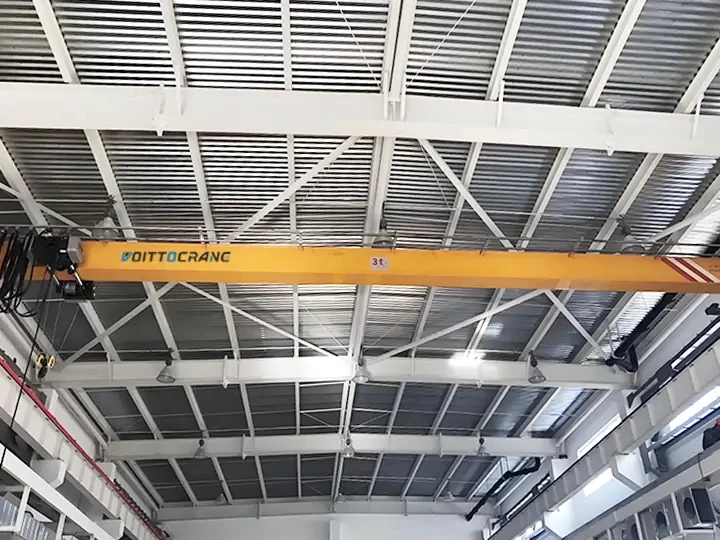
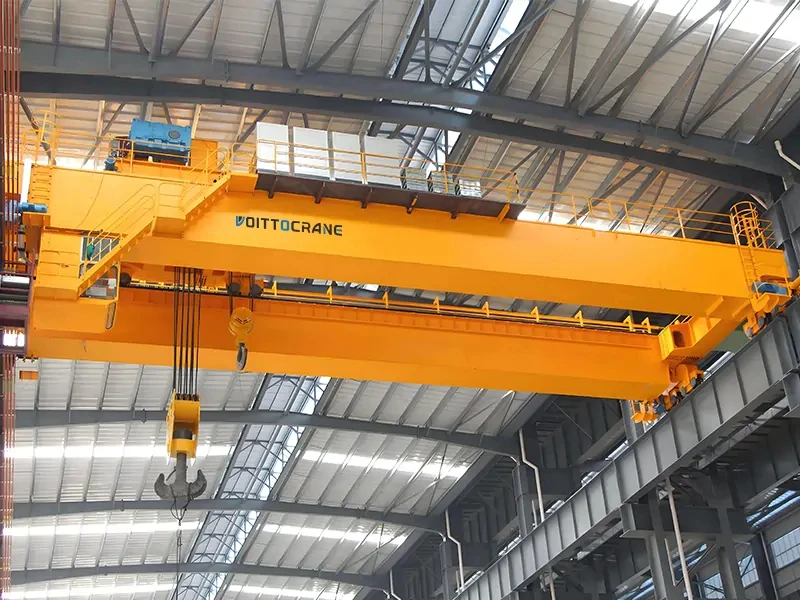
A overhead crane usually consists of a bridge frame, traveling mechanism, trolley, hoisting mechanism, and electrical control system. Because of its large coverage area, high lifting capacity, and stable operation, it is widely used in industrial fields such as machinery manufacturing, steel metallurgy, warehousing and logistics, automobile manufacturing, and large equipment assembly.
Parts of a Bridge Crane
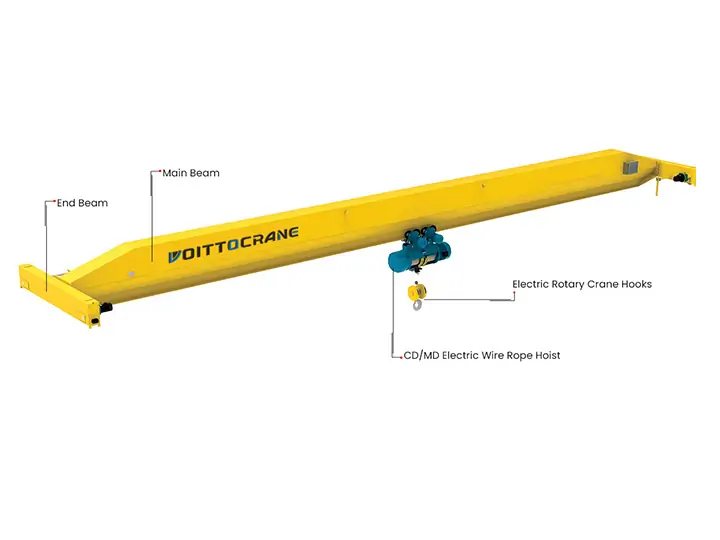
It mainly consists of several key components that work together to complete material lifting and transportation. Its core components mainly include the following aspects:
Bridge frame:
The bridge frame is the main structure, usually composed of main girders and end girders. It spans the tracks on both sides of the workshop, providing support for the trolley operation while bearing the main load generated during lifting.
Bridge traveling mechanism:
The traveling mechanism is installed at both ends of the bridge frame. Driven by a motor, it moves the entire bridge along the tracks on both sides of the workshop, enabling the crane to cover a large working area.
Trolley traveling mechanism:
The trolley is installed on the bridge girder and can move longitudinally along the girder. The hoisting mechanism is usually installed on the trolley, which is an important component for lifting operations.
Hoisting mechanism:
The hoisting mechanism mainly consists of an electric hoist, drum, steel wire rope, and hook. It is used to lift and lower heavy objects and is the core device for lifting operations.
Electrical control system:
The electrical control system is used to control the operation of the crane, including the control cabinet, control buttons, or remote control devices, enabling operators to control the crane safely and accurately.
These core components work together to enable the bridge crane to perform horizontal movement, longitudinal movement, and vertical lifting, thereby efficiently completing various industrial lifting tasks.
Working Principle of a Bridge Crane
Utilizing the coordination of multiple operating mechanisms to realize the lifting, movement, and positioning of heavy objects in space. It mainly relies on the cooperation of the hoisting mechanism, trolley traveling mechanism, and bridge traveling mechanism to complete lifting operations.
Hoisting mechanism:
Responsible for lifting and lowering heavy objects. The motor drives the drum to rotate, which moves the steel wire rope, allowing the hook to lift or lower the load.
Trolley traveling mechanism:
Installed on the bridge girder. Driven by a motor, it allows the trolley to move left and right along the girder, enabling horizontal transportation of loads on the bridge.
Bridge traveling mechanism:
Installed at both ends of the bridge frame. The driving device moves the entire bridge forward and backward along the tracks on both sides of the workshop, allowing the crane to cover a larger working area.
Through the combination of bridge movement, trolley movement, and vertical lifting of the hoisting mechanism, the bridge crane forms a three-dimensional material handling system within the workshop, efficiently completing various lifting and transportation tasks.
What is a Monorail Crane?
A monorail crane, also called a KBK crane, is a light lifting device that runs along a single rail or I-beam track. It is usually used with an electric hoist and is designed to complete lifting and transportation along a fixed route. It is suitable for point-to-point material transportation in production lines or process flows.


Parts of a Monorail Crane
Monorail crane System consists of a rail beam, electric hoist, traveling mechanism, and support structure. The structure is simple and lightweight. The equipment is generally installed on factory beams, brackets, or steel structures. The electric hoist runs along the monorail while completing lifting and moving operations. The lifting capacity is usually between 0.5 tons and 10 tons, making it suitable for small and medium-sized material handling.
Single rail crane equipment is easy to install, has lower cost, and occupies little space. It is widely used in production line transportation, assembly workshops, warehouse material transfer, painting lines, and packaging workshops. It is an important solution for many industrial enterprises to achieve lightweight material handling.

Working Principle of a Monorail Crane
A single rail crane completes lifting operations through an electric hoist running along the monorail. The equipment is installed on an I-beam or special rail track. The electric hoist moves back and forth along the track through the traveling mechanism while lifting or lowering loads through the hoisting mechanism.
Operators control the hoist movement and lifting operations through a pendant controller or remote control, allowing materials to be transported along the preset monorail route. It is particularly suitable for material transfer between production lines, assembly lines, or specific workstations.
This working method has a simple structure and stable operation, enabling efficient material handling in limited spaces. It is a common lifting device in many light industrial applications.
Main Differences Between Bridge Cranes and Monorail Cranes
| Comparison Item | Bridge Crane | Monorail Light Crane |
| Structure | Consists of bridge frame, bridge traveling mechanism, trolley, and hoisting mechanism; structure is more complex | Consists of a single rail and electric hoist; structure is simple |
| Operation Mode | Bridge travels along factory tracks while the trolley moves across the bridge, enabling three-dimensional movement | Electric hoist runs along a single track and usually moves only along a fixed path |
| Coverage Area | Can cover the entire workshop or operation area | Limited to the preset track route |
| Lifting Capacity | Usually from 1 ton to 800 tons | Usually from 0.5 ton to 10 tons |
| Installation Requirements | Requires runway beams or special supporting structures | Simple installation on I-beam or factory beams |
| Equipment Cost | Higher equipment and installation cost | Lower cost, suitable for light material handling |
| Application | Heavy industries such as steel, machinery manufacturing, and equipment assembly | Production lines, assembly lines, warehouses, and light material transport |
Typical Application Scenarios of Bridge Cranes and Monorail Crane
| Equipment Type | Typical Industry | Application Scenario |
| Bridge Crane | Steel metallurgy | Steel lifting, steel coil handling, smelting workshop transport |
| Machinery manufacturing | Large equipment assembly, machine component lifting | |
| Automobile manufacturing | Body production line equipment installation and heavy component handling | |
| Warehousing and logistics | Heavy cargo loading and unloading | |
| Power and energy | Power equipment installation and maintenance | |
| Monorail Crane | Production assembly lines | Material transfer between processes |
| Warehouse and logistics centers | Small cargo handling and sorting | |
| Painting and surface treatment workshops | Workpiece transportation on coating lines | |
| Food and packaging industry | Packaging material transportation | |
| Electronics and light manufacturing | Small parts handling and assembly support |
How to Choose the Right Crane?
Enterprises can select suitable lifting equipment according to production needs, working environment, and equipment parameters through the following key factors.
1. Lifting Capacity Requirement
First determine the maximum weight of the materials to be lifted. If heavy equipment or large components need to be lifted, a monorail lifting systemis usually selected. For lighter material handling, a monorail crane can meet the requirements.
2. Working Range
If the crane needs to cover the entire workshop or a large working area, a bridge crane is more suitable. If materials only need to move between fixed stations, a monorail crane is a more economical choice.
3. Working Frequency
For high-frequency and continuous lifting operations, a crane system with stronger structure and higher stability should be selected to ensure long-term stable operation.
4. Installation Conditions
Enterprises need to consider factory structure, available space, and rail installation conditions. If the building structure cannot support bridge crane rails, a monorail crane or other light lifting systems can be considered.
5. Cost and Maintenance
In addition to crane purchase costs, installation costs, maintenance expenses, and future spare part replacement costs should also be considered in order to choose the most cost-effective solution.
Bridge Crane vs Monorail Light Crane: Pros and Cons
Bridge Crane
Advantages:
Large lifting capacity, capable of handling heavy equipment; wide coverage area within the workshop; stable operation suitable for high-frequency work; high working efficiency.
Disadvantages:
Higher equipment and installation costs; higher requirements for building structures; longer installation period.
Light Monorail Crane
Advantages:
Simple structure, easy installation; lower equipment and maintenance costs; occupies less space; suitable for production line material transport.
Disadvantages:
Lower lifting capacity; can only operate along fixed tracks; limited working range, not suitable for large-area handling.
Conclusion
By comprehensively considering lifting capacity, working range, operating frequency, installation conditions, and cost factors, selecting the appropriate equipment according to specific working conditions can not only improve production efficiency but also reduce long-term operating costs.
VOITTO is a professional bridge crane and a monorail crane manufacturer in China. We have an experienced and professional sales team. If you need detailed technical specifications or industry-specific solutions, please feel free to contact us.
FAQ
1. What is the difference between a bridge crane and a monorail crane?
A bridge crane runs on two parallel tracks and can cover a large working area, while a monorail crane runs along a single fixed track and is mainly used for linear material transportation.
2. Which is better: a bridge crane or a monorail crane?
It depends on the specific application scenario. Bridge cranes are more suitable for heavy-duty operations and large working areas, while monorail cranes are suitable for light lifting and production line transportation.
3. What are the advantages of a monorail crane?
Monorail cranes have a compact structure, high cost-effectiveness, and easy installation, making them suitable for fixed-route material handling in assembly lines or workshops.
4. When should a bridge crane be chosen instead of a monorail crane?
When the operation requires heavy lifting, large coverage areas, and high-frequency lifting operations, a bridge crane should be preferred.
5. Which industries use bridge cranes and monorail cranes?
Bridge cranes are widely used in steel plants, manufacturing industries, warehouses, and heavy industries, while monorail cranes are commonly used in assembly lines, packaging plants, and light manufacturing workshops.
6. What is the difference in lifting capacity between bridge cranes and monorail cranes?
Bridge cranes typically handle loads ranging from several tons to hundreds of tons, while monorail cranes usually handle light loads from 0.5 to 10 tons.
7. Are monorail cranes more economical than bridge cranes?
Yes, monorail cranes usually have lower initial investment costs.
8. Can a monorail crane replace a bridge crane?
Not always. Monorail cranes are designed for linear movement and light loads, while bridge cranes can cover the entire area and provide higher lifting capacity.
9. Which is easier to install, a monorail crane or a bridge crane?
Monorail cranes are usually easier and faster to install because they only require a single track, while bridge cranes require more complex structural support and runway systems.




 English
  Español
  Português
  العربية
  Français
  Русский