Monorail cranes are suspended lifting devices that operate along a single fixed rail. Using electric hoists, they can transport materials along straight or curved paths to designated points. They are used in indoor industrial environments such as workshops, production lines, and warehouses, and are suitable for material handling scenarios where there are defined logistics routes between workstations.
This article systematically introduces the structural characteristics, common types, primary components, and operating principles of these systems. It analyzes their differences from bridge cranes and jib cranes through typical industrial applications. Additionally, it outlines selection criteria for monorail cranes based on key factors such as lifting capacity, track layout, and operating conditions.
- 1 What Is a Monorail Crane?
- 2 Types of monorail crane
- 3 monorail crane parts
- 4 How Does a Monorail Crane System Work?
- 5 Monorail Crane Applications in Industrial Facilities
- 6 Monorail Crane vs Bridge Crane vs Jib Crane
- 7 Advantages of Monorail Cranes
- 8 Custom Monorail Cranes
- 9 Custom Monorail Crane Solutions for Different Regions
- 10 Monorail Crane Manufacturer & Supplier Considerations
- 11 Conclusion
- 12 FAQs


What Is a Monorail Crane?
the cranes are overhead lifting devices installed within factory buildings, transporting materials from one workstation to another along a fixed rail. These systems operate along predetermined routes and are primarily used in production and assembly scenarios where workpieces require movement according to fixed processes. They feature a simple structure and offer flexible operation.
Types of monorail crane
Monorail cranes can be classified based on their track structure and system configuration. The following are common types:
I-Beam Monorail Crane
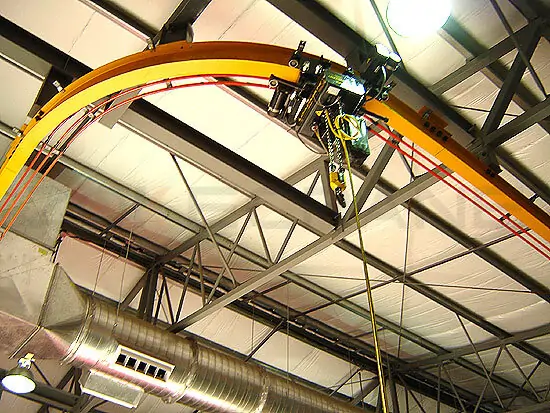
The running track of the I-beam monorail crane consists of I-beams or H-beams, with an electric hoist traveling along a single beam. It is designed for material handling applications requiring fixed routes, such as machining shops, steel structure fabrication, and heavy component transfer. Characterized by its compact structure and stable operation, it suits point-to-point or linear transport needs for medium-load applications.
- Lifting Capacity: 0.5–10 tons
- Track Span: Customized based on facility structure
- Travel Path: Straight / Configurable curves
- Lifting Height: Determined by installation conditions
- Working Class: A3–A5
KBK Monorail Crane System
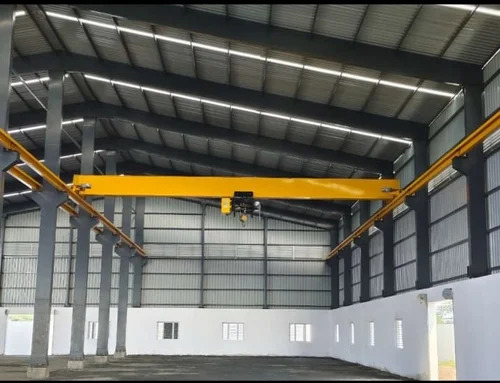
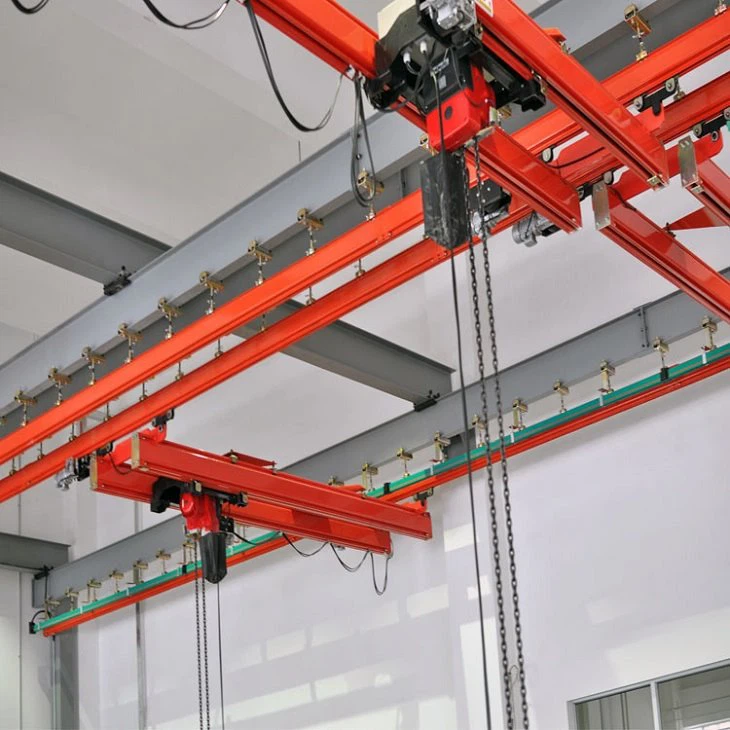
The KBK Crane System is designed for light material handling. Its lightweight rails and modular components enable smooth transfer of workpieces between different workstations. Straight sections, curves, and switches can be flexibly arranged according to site requirements, making it ideal for assembly lines, manual workstations, and other operations requiring frequent handling and convenient operation.
- Lifting Capacity: 0.125–2 tons
- Track Type: Cold-rolled steel track / Aluminum alloy track
- Travel Path: Straight, curved, switch
- Operation Mode: Manual / Electric
- Lifting Height: Determined by on-site installation conditions
- Duty Cycle: A2–A4

Underhung Single Girder Monorail Crane
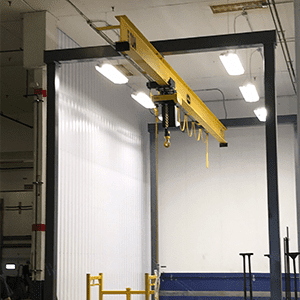
Underhung Single Girder Monorail Crane is installed beneath factory beams, transporting materials along fixed routes via a single main girder. It occupies no floor space, making it ideal for environments with limited ceiling height but requiring large spans for inter-station material transfer.
- Lifting Capacity: 1–10 tons
- Structure Type: Single-girder suspended
- Span: Customized based on factory beam spacing
- Travel Route: Unidirectional or limited route
- Lifting Height: Dependent on factory clearance conditions
- Duty Cycle: A3–A5

monorail crane parts
Monorail cranes primarily consist of tracks, suspension units, hoisting mechanisms, and other functional components, enabling stable material transport along predetermined routes. The system features a streamlined structure with high modularity, allowing configuration and adjustment based on site conditions.
- Track System: Tracks utilize I-beam or lightweight structural steel construction, with layouts configurable for straight or curved paths to transport materials between different workstations.
- Suspension and Support Devices: Secure the tracks to factory beams or steel structures, effectively distributing loads to reduce additional stress on building structures, ensuring long-term stable operation.
- Hoisting Mechanism (Electric Hoist): Performs material lifting and lowering, serving as the core operational component of monorail cranes. Manual or electric versions are available based on load capacity and usage frequency.
- Travel Trolley and Wheels: Supports smooth travel of the hoisting mechanism along the track with minimal resistance and low noise, ensuring reliable and seamless lifting operations.
- Control and Safety Components: Includes control handles, limit switches, and other devices for precise operation and fundamental safety protection.
How Does a Monorail Crane System Work?
Monorail cranes operate on I-beam tracks or KBK light-duty tracks as their running base, with the hoisting mechanism suspended beneath the track. Electric hoists handle the lifting and lowering of cargo. These hoists can traverse the rails via manual or electric trolleys, enabling material movement between different workstations. Depending on production requirements, the rail system can be designed as straight, curved, or incorporating switches to accommodate fixed or multi-route material transfer needs.
Monorail Crane Applications in Industrial Facilities
Monorail cranes are commonly used for material handling along fixed production and logistics routes inside factories and workshops. They are well suited to repetitive lifting tasks where components need to move efficiently between machining, assembly, testing, and storage areas.
Common applications include:
- Automotive Manufacturing Plants: Moving components along assembly lines and transferring parts between production stations.
- Steel Structure Fabrication Shops: Handling beams, fabricated sections, and welded components between cutting, welding, and assembly areas.
- Machinery Manufacturing Plants: Lifting, positioning, turning, and assembling machine parts, motors, frames, and other heavy components.
- Chemical Pump Manufacturing: Transferring pump casings, impellers, motors, shafts, baseplates, and assembled industrial chemical pumps between machining, assembly, testing, and packing stations.
- Warehousing and Logistics Centers: Providing point-to-point lifting and internal transport for heavy or oversized materials.
- General Production Workshops: Improving material flow between fixed workstations while reducing reliance on forklifts and manual handling.

Monorail Crane vs Bridge Crane vs Jib Crane
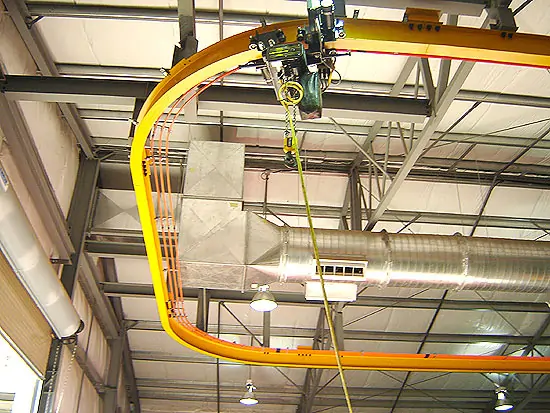
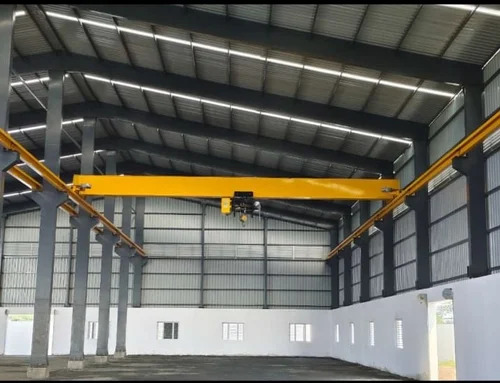
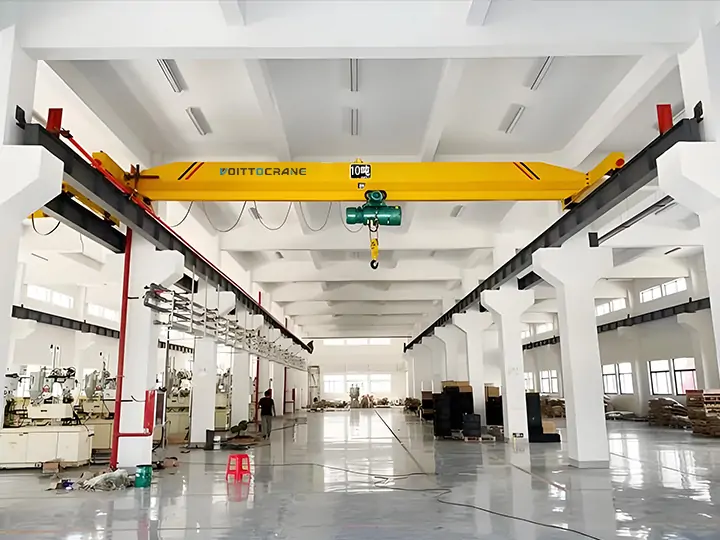
Monorail cranes, bridge cranes, and jib cranes differ significantly in structure and application. The following table provides a brief comparison of the three types.
| Item | Monorail Crane | Bridge Crane | Jib Crane |
|---|---|---|---|
| Rail Structure | Single suspended rail | Single or double girder bridge | Cantilever jib structure |
| Working Area | Fixed point-to-point path | Full area coverage | Single workstation |
| Space Requirement | No floor space, low headroom | Larger overhead space required | Floor or wall space required |
| Typical Capacity | 0.125–10 tons | 1–100+ tons | 0.25–5 tons |
| Application | Production lines, workshop transfer | Large span, overall lifting | Frequent lifting at one station |
| Selection Focus | Fixed process, cost-effective | Maximum coverage | Localized operation |
For a full comparison of bridge cranes and monorail cranes — including working principles, application tables, pros and cons, and a 5-step selection guide — see our Bridge Crane vs Monorail Crane guide.
Advantages of Monorail Cranes
The following are the advantages of the cranes:
- Suitable for material handling along fixed routes, with flexible route design.
- The hoisting system is suspended, occupying no floor space.
- Track layout can be customized according to workshop workstations and logistics requirements.
- Simple structure with low installation and maintenance costs.
- Enhances material handling efficiency while reducing manual operation risks.
Custom Monorail Cranes
We need to understand your specific operating conditions and usage requirements to provide the most suitable monorail crane solution and quotation. Please provide the following information:
- Monorail Crane Type: Select the system configuration suitable for your production process (e.g., I-beam, KBK, or suspended single-girder).
- Lifting Capacity: Determine the required load range to ensure safety and efficiency.
- Track Dimensions and Layout: Including span, length, height, and travel route design.
- Power Specifications: E.g., 380V 50Hz three-phase, or customized per site requirements.
- Operation Mode: Electric trolley or manual trolley.
- Control Method: Pendant control, remote control, or customized control solutions.

Custom Monorail Crane Solutions for Different Regions
Monorail cranes can be customized to meet the specific requirements of different regions and factories:
- North American workshops: Designed to meet high safety standards and industrial processes.
- European projects: Compliant with CE certification requirements and stringent quality standards.
- Emerging markets: Offering cost-effective, easy-to-install solutions
Monorail Crane Manufacturer & Supplier Considerations
When selecting monorail cranes, focus on the professional capabilities of manufacturers and suppliers. Quality suppliers can provide custom design solutions tailored to specific operating conditions and offer comprehensive engineering support throughout system planning, installation, and commissioning phases.
Conclusion
Monorail cranes are ideal for material handling along fixed routes in factory workshops, production lines, and warehouses. This article outlines their types, components, operating principles, and typical applications. It compares monorail cranes with bridge and jib cranes, offering design and selection guidance to help you quickly identify the right equipment. If you’re still mapping out which crane type suits each area of your facility, the indoor crane types guide covers overhead, gantry, jib, and monorail systems together with selection criteria for factories and warehouses. Provide your lifting requirements and track layout, and voitto will design a customized solution, provide a quote, and deliver installation and engineering support.
FAQs
Q1: What is the typical load capacity of a monorail crane?
Capacity depends on the system type. KBK light-rail systems handle 0.125–2 tons; I-beam and underhung configurations typically cover 1–10 tons. If your load exceeds 5 tons with frequent daily cycles (duty class A4+), an underhung single-girder system is more appropriate than a KBK setup, which is optimized for light, repetitive transfers.
Q2: Where are these systems commonly used?
Primarily in production lines and workshops where materials follow fixed routes — automotive assembly, steel fabrication, and precision machinery are the most common. They are less suitable where full-bay coverage is needed; a bridge crane serves that use case better.
Q3: Can the rail layout be customized?
Yes. Straight runs, curves, and switch tracks can all be combined. The practical constraint is minimum curve radius: standard KBK systems require a curve radius of ≥ 1,000 mm; I-beam systems depend on the hoist wheel gauge and are generally less flexible on curves.
Q4: Do these cranes meet international safety standards?
Systems can be built to CE (Machinery Directive 2006/42/EC) for Europe or OSHA 1910.179 for North America. Confirm which standard applies before issuing the RFQ — the structural calculation basis and documentation package differ significantly between the two.
Q5: What should I verify when evaluating a supplier?
Three things: whether they provide stamped engineering drawings (not just catalog specs), whether the hoist duty class matches your actual cycle requirements, and whether post-sale spare parts — particularly hoist chains and trolley wheels — are stocked locally or require overseas lead time.




 English
  Español
  Português
  العربية
  Français
  Русский