
Searching for a 3 ton gantry crane for sale means you already know the fundamentals: 3,000 kg of rated lift capacity, a self-supporting structure, and no need to modify your building. What takes more thought is which type fits your site — and what separates a reliable long-term investment from a unit that creates problems within a year.
This guide covers six types of 3 ton gantry cranes, their specifications, the scenarios each handles best, and the key factors to confirm before placing an order. Read through, and the right choice becomes straightforward.
- 1 Six Types of 3 Ton Gantry Crane
- 2 Single Girder Gantry Crane — The Industry Standard
- 3 Double Girder Gantry Crane — For Heavy Loads and Future Scalability
- 4 3 ton Truss Gantry Crane — Wind-Resistant and Outdoor-Ready
- 5 Portable Gantry Crane — No Foundation, Maximum Flexibility
- 6 Semi Gantry Crane — Space-Saving for Indoor Facilities
- 7 Hydraulic Gantry Lifting System — Precision in Confined Spaces
- 8 Key Factors to Confirm Before You Order
- 9 Summary: Three Questions That Determine Your Choice
-
10
3 Ton Gantry Crane for Sale FAQ
- 10.1 Q1: What is the rated lifting capacity of a 3 ton gantry crane?
- 10.2 Q2: Can a 3 ton gantry crane be used outdoors?
- 10.3 Q3: What is the difference between a single girder and double girder 3 ton gantry crane?
- 10.4 Q4: How does a truss gantry crane compare to a standard box beam type?
- 10.5 Q5: What certifications should I require when sourcing a 3 ton gantry crane?
Six Types of 3 Ton Gantry Crane
| Type | Capacity Range | Span | Lifting Height | Mobility | Best For |
|---|---|---|---|---|---|
| Single Girder Gantry Crane | 2–32 t | 5–35 m | 6–24 m | Rail-fixed | General workshop, logistics |
| Double Girder Gantry Crane | 5–800 t | 6–40 m | 5–30 m | Rail-fixed | Heavy-duty, large span |
| Truss Gantry Crane | 3–100 t | Custom | Custom | Rail / outdoor | Open yards, windy sites |
| Portable Gantry Crane | 0.5–10 t | 12–30 m | 6–9 m | Wheeled | Workshop, temporary lifting |
| Semi Gantry Crane | 2–32 t | 5–35 m | 6–24 m | Rail + wall | Space-limited indoor facility |
| Hydraulic Gantry Lifting System | Custom | Custom | Custom | Track legs | Precision installation, low headroom |
Single Girder Gantry Crane — The Industry Standard
What Is Single Girder Gantry Crane
The single girder gantry crane uses one main beam supported by two legs running on ground rails. It is the most widely deployed gantry type globally — valued for its structural simplicity, cost efficiency, and configurable span range. The structure includes the main beam, end beams, support legs, ground beams, electric hoist, and optional cab.
Key Specifications (3 Ton)
- Lifting capacity: 2–32 t (3 t is a standard configuration)
- Span: 5–35 m | Lifting height: 6–24 m | Duty: A3–A5
- Hoist: Electric wire rope hoist or chain hoist
- Control: Pendant or wireless remote

Typical Application Scenarios
Manufacturing workshops, logistics centers, warehouses, and construction sites. Full customization of span, height, and lifting speed makes it adaptable to almost any site layout. It is the most practical starting point for buyers comparing 3 ton gantry cranes across suppliers.
Double Girder Gantry Crane — For Heavy Loads and Future Scalability
Structural Advantages Over Single Girder
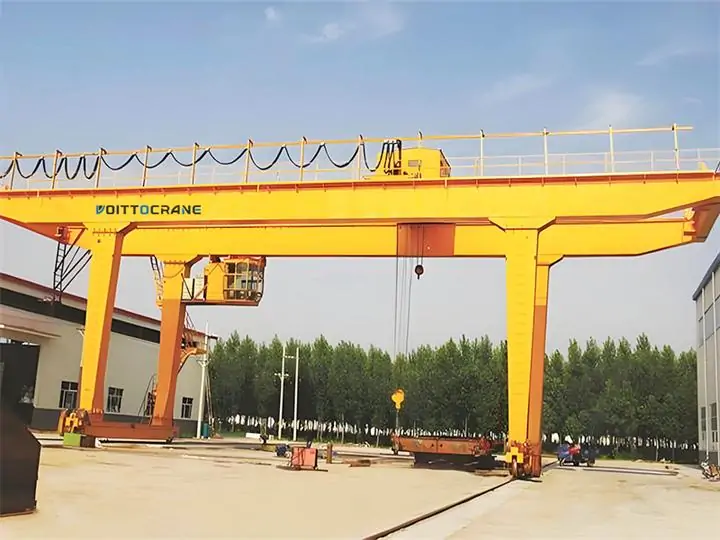
The 3 ton double girder design uses two parallel main beams for significantly higher structural rigidity, better hook height, and heavier duty cycle performance. At the 3 ton level, a double girder is less common — but buyers who anticipate scaling loads beyond 5 tons, or who need longer spans with higher stability, sometimes specify this configuration from the outset.
Key Specifications
- Lifting capacity: 5–800 t (lower capacities available on request)
- Span: 6–40 m | Lifting height: 5–30 m | Duty: A5–A7
- Structure: Box-type double girder with open winch or enclosed hoist trolley
When to Specify Double Girder
Shipyards, steel mills, large construction sites, and facilities planning for production expansion. The double girder supports trolley-mounted open winch systems, providing more precise hook positioning and higher lifting speeds than a standard hoist. For buyers purchasing a 3 ton crane today with plans to scale, this type builds in the most operational headroom.
3 ton Truss Gantry Crane — Wind-Resistant and Outdoor-Ready
Why Truss Structure for Outdoor Use
The 3 ton truss gantry crane replaces the solid box beam with a welded steel tube or section truss structure. It is lighter than a comparable box beam, has a lower wind resistance coefficient, and costs less to fabricate at larger spans.
Two configurations are available: the MH Type single girder for light-duty or space-constrained applications, and the MG Type double girder for heavy-duty, large-span operations. Both cover 3–100 tons.

Key Specifications (3 Ton)
- Hoist: Chain hoist or wire rope hoist
- Lifting capacity: 3–100 t | Duty: A3–A5
- Advantages: Low dead weight, strong wind resistance, bolt/pin disassembly for relocation
Ideal Site Conditions
Open-air freight yards, stone yards, prefabricated component factories, ports, and shipyards. The open truss framework gives operators a clear sightline to the suspended load — a practical safety advantage in busy outdoor environments. The bolt/pin connection system also makes truss cranes easier to disassemble and relocate between project phases.
Portable Gantry Crane — No Foundation, Maximum Flexibility
What Is Portable Gantry Crane
The portable gantry crane is a steel-framed mobile unit that requires no permanent foundation. Height and span are adjustable within the design range. It can be moved between workstations on universal braked castors, assembled or disassembled without specialized tools, and shipped cost-effectively as a complete unit.
Hoisting options include manual chain block, electric chain hoist, or electric wire rope hoist — selected based on duty requirements and lift height. Steel vs aluminum frame, hoist type, and span all affect the final FOB price significantly — the mobile gantry crane for sale guide gives factory-direct price benchmarks across the 0.5–10 ton range for both manual and electric configurations.

Key Specifications (3 Ton)
- Lifting capacity: 0.5–10 t (3 t standard)
- Span: 12–30 m | Lifting height: 6–9 m | Duty: A3
- Structure: Steel box or truss main beam, adjustable legs, braked universal castors
Real-World Case: Mexico Metal Parts Factory
A metal parts factory in Mexico needed a lifting solution for mold changes and heavy component handling — but had limited ceiling height, a frequently reconfigured production line, and no budget for civil engineering work.
Voitto Crane supplied a 2 ton portable gantry crane: 6.5m span, 8.5m lifting height, wire rope electric hoist, A3 duty, 380V/50Hz/3-phase. The modular structure allowed the team to complete installation independently. The crane was in production use within days.
Project leader Sebastián noted the unit was cost-effective, easy to operate, and fully met their production needs. The factory has since planned additional units for their next expansion.
Who Should Choose This Type
Workshop machinery transport, construction site hoisting, warehouse multi-station logistics, and any temporary lifting operation where a fixed installation is not feasible. Global voltage standards are supported across all export configurations.
Semi Gantry Crane — Space-Saving for Indoor Facilities
How One-Side Wall Support Works
The semi gantry crane runs one leg on a ground rail and uses an existing building wall beam or column to support the other side. This eliminates one full ground rail, saves significant floor space, and reduces civil construction cost compared to a full two-legged gantry.
Voitto Crane offers a light-duty single girder type for standard workshop use, and a heavy-duty configuration scaling up to 320 tons for demanding production environments.
Key Specifications (3 Ton)
- Lifting capacity: 2–32 t (3 t standard) | Span: 5–35 m | Height: 6–24 m
- Duty: A4 | Features: High space utilization, high positioning accuracy, low maintenance cost
- Optional: Anti-corrosion or anti-dust device customization

Where It Works Best
Small-to-medium manufacturing plants, automobile production lines, logistics warehouses, and any facility where floor space is a genuine constraint. The building wall or column must be assessed by a structural engineer to confirm load-bearing capability before installation. For the right indoor environment, the semi gantry delivers full gantry performance at roughly half the ground-level footprint.
Hydraulic Gantry Lifting System — Precision in Confined Spaces

How Hydraulic Lifting Differs from Electric
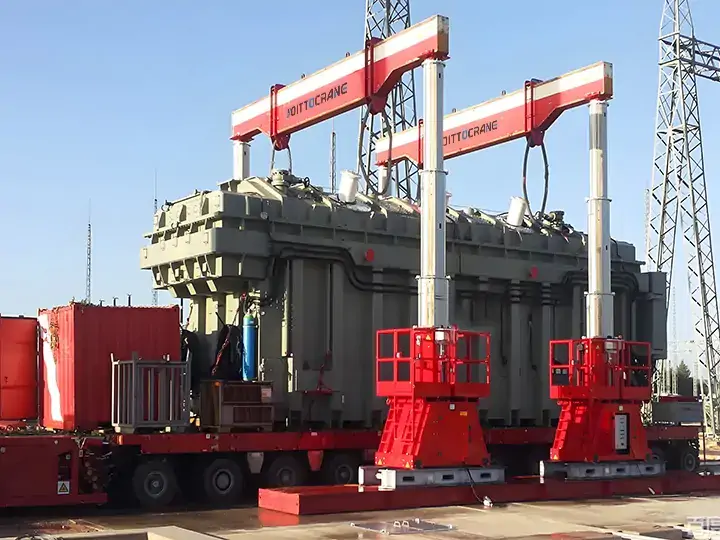
The hydraulic gantry lifting system is an entirely different category from conventional electric gantry cranes. It uses multi-stage hydraulic telescopic columns as the lifting mechanism, controlled synchronously so that all legs maintain the same height throughout the lift.
The system consists of hydraulic gantry legs, an upper header beam, a base frame, lifting cylinders with load distribution and synchronous control, a travelling mechanism, and a track system. Two or four legs are typically used depending on load and configuration.
This equipment lifts and installs large-tonnage equipment with millimeter-level precision — even in low-headroom environments where conventional cranes cannot operate.
Recommended Applications
Power plants, petrochemical facilities, heavy manufacturing sites, bridge construction projects, and large equipment maintenance operations. The hydraulic gantry is not a routine production crane — it is a precision installation tool. For buyers whose 3 ton requirement involves complex equipment positioning rather than standard material handling, this is the category to evaluate specifically.
Key Factors to Confirm Before You Order
Working Duty Class
This single specification is the most commonly underestimated by buyers. Selecting a lower duty class than your operation demands leads to accelerated wear, increased breakdown frequency, and premature replacement costs.
- A3: Occasional lifts, infrequent use — portable cranes, light workshop
- A4: Regular multi-shift use — semi gantry, standard single girder
- A5+: High-frequency production duty — double girder, heavy truss type
Headroom and Net Lifting Height
Net usable lifting height is not the same as the crane’s structural height. The hoist or trolley mechanism consumes vertical space inside the frame. Low-headroom hoist models recover 200–400mm of clearance vs. standard configurations — a critical specification on sites with ceiling height constraints.
Indoor vs. Outdoor Use
For outdoor operations, hoist and electrical components must carry IP55 or IP65 protection ratings. Ground bearing capacity must support the combined wheel load of the crane plus the rated lifted load. Truss and portable types are the most common outdoor configurations at the 3 ton capacity level.
Certifications
For international orders: CE marking (EU Machinery Directive 2006/42/EC), ISO 9001 quality documentation, load test certificates, and FEM duty class documentation. For North American projects: ASME B30 compliance. Request all documents before payment — not after delivery.
Summary: Three Questions That Determine Your Choice
- How often will the crane be used? Light intermittent use → portable or single girder. Daily production duty → double girder or semi gantry.
- Does it need to move between locations? Yes → portable gantry. No → rail-fixed type for better duty capacity.
- Is space or headroom constrained? Floor space limited → semi gantry. Low headroom + precision installation → hydraulic gantry system.
For complex requirements — non-standard spans, specialized environments, or multi-unit orders — manufacturer consultation and a customized quote deliver the most reliable outcome.
3 Ton Gantry Crane for Sale FAQ
Q1: What is the rated lifting capacity of a 3 ton gantry crane?
The rated lifting capacity is 3,000 kg, approximately 6,600 lbs. This is the maximum safe working load under normal operating conditions. Overloading beyond the rated capacity poses serious safety risks and voids equipment certification. If loads regularly approach 3 tons, consider specifying a 5 ton crane to build in a safe working margin. The next size up also extends component service life under real-world operating conditions where loads are not always perfectly managed.
Q2: Can a 3 ton gantry crane be used outdoors?
Yes, with the correct configuration. Portable and truss gantry cranes are the most common choices for outdoor use. Hoist and electrical components should carry IP55 or IP65 weather protection. The ground must be flat and capable of bearing the crane’s wheel loads plus rated load. For coastal or chemically active environments, anti-corrosion coatings and stainless hardware are recommended. Voitto Crane designs gantry cranes for stable operation in strong wind and low-temperature conditions through special construction and material specification.
Q3: What is the difference between a single girder and double girder 3 ton gantry crane?
A single girder crane uses one main beam and is more cost-effective, easier to install, and sufficient for most 3 ton applications with standard duty requirements. A double girder uses two parallel beams, providing greater rigidity, better hook height, heavier duty cycle ratings, and compatibility with open winch trolley systems. At the 3 ton level, a single girder is the practical choice for most buyers. Double girder makes sense when you anticipate scaling loads above 5 tons, need longer spans, or require higher duty cycle performance from day one.
Q4: How does a truss gantry crane compare to a standard box beam type?
A truss gantry crane uses a lattice of welded steel tubes instead of a solid box beam. This gives lower dead weight, lower wind resistance, lower material cost for equivalent spans, and a clear operator sightline through the open structure — a safety advantage in busy outdoor environments. Box beam types offer a more enclosed, robust structure better suited for indoor high-frequency operations where wind load is not a factor. At the 3 ton capacity level, a truss type is often the most cost-effective choice for outdoor yards and open storage facilities.
Q5: What certifications should I require when sourcing a 3 ton gantry crane?
At minimum: CE marking for EU and international markets, ISO 9001 quality management certification, and factory load test documentation. FEM duty class certification confirms the crane is rated for your actual operational intensity. For North American projects, ASME B30.2 and CMAA standards apply. Always request factory test certificates, load test reports, and complete product documentation as part of the export package. A reliable manufacturer provides these as standard. Any supplier unable to produce them on request should be evaluated carefully before committing to an order.


 English
  Español
  Português
  العربية
  Français
  Русский