
A jib crane is a type of industrial lifting equipment that uses a projecting arm — known as the jib or boom — to support a hoist and move loads within a defined work area.
A Cantilever jib crane is one of the ideal solutions for lifting and transporting materials in industrial workshops and manufacturing plants, and is known for their simple structure, low cost, and wide application. Next, this article will introduce the definition, types, prices, specifications, and other relevant information about cantilever jib cranes, enabling you to understand them and select the most economical and efficient lifting equipment for your factory.

Floor Mounted Slewing Jib Crane

Wall Travelling Cantilever Crane
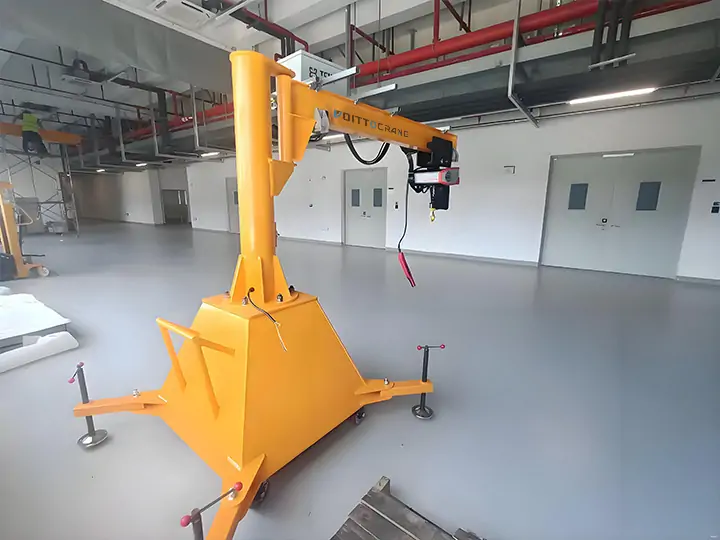
Portable Cantilever Jib Cranes

Wall Mounted Cantilever Cranes

Articulating Cantilever Jib Crane
What is a Jib Crane?
A jib crane is a type of lifting equipment built around a horizontal arm known as the jib or boom, which supports a movable hoist and allows loads to be lifted and swung within a defined radius. A jib, which is like a gantry, supports a movable lifting mechanism that may be on the wall or on the ground. In addition, this crane boom can rotate, This rotating capability is what distinguishes a jib crane from fixed hoists and makes it far more flexible for workstation-level operations. allowing the lifting system and load to make circular or semi-circular movements. Typically, users use it for material handling in localized work areas such as industrial workshops, small production lines, and warehouse loading and unloading. Whether in workshops, production lines, loading and unloading areas, or maintenance stations, cantilever jib cranes can quickly and safely complete material handling tasks in environments where large lifting equipment is not suitable. Among all jib crane types, the cantilever jib crane is the most widely used configuration in industrial environments — and that is the focus of this article.
Types of Jib Cranes
Cantilever jib crane manufacturers classify them into the following five different types based on their installation method, structural form, and application scenario:

Floor Mounted Slewing Cantilever Jib Crane
The floor-mounted slewing cantilever jib crane uses a column as the support structure, with the jib and slewing mechanism covering the working area. The entire machine can rotate 180°, 270°, or 360°, providing a wide coverage area. Installed on the ground, it does not rely on building structures and features a simple structure, convenient operation, small footprint, and high efficiency for fixed-point operations.
What is a Portable Jib Crane?
The portable mobile cantilever crane‘s base is equipped with a travelling mechanism, allowing the equipment to move freely. The equipment can be quickly deployed between different workstations via a running system. This equipment is easy to transport, requires no ground support, and is suitable for temporary hoisting, maintenance work, confined spaces, or scenarios where a fixed crane cannot be arranged.
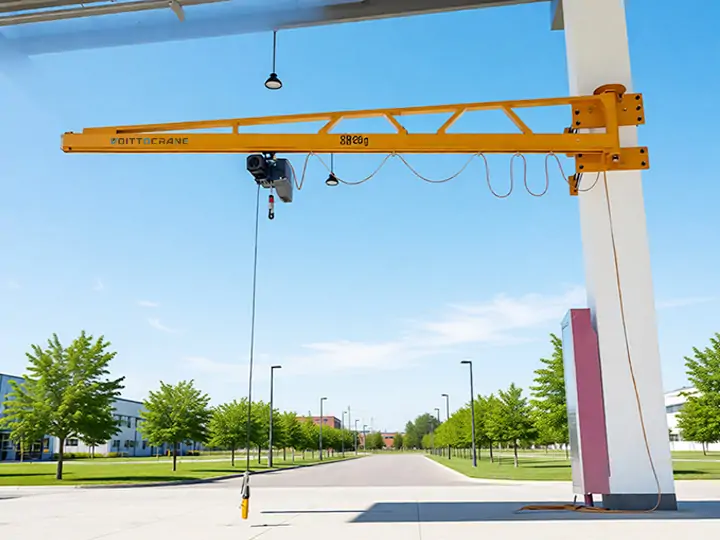
Wall Mounted Cantilever Cranes
Wall-mounted cantilever cranes are installed on walls or building columns. By extending the cantilever along the wall, they can lift and move materials in a localized area. The equipment does not require ground foundation and does not occupy floor space, the cantilever can rotate within a 180° range. Their advantages include space saving, easy installation, and low cost.
Wall Travelling Jib Crane
Wall-travelling jib cranes are installed on workshop walls or columns, occupying no floor space, and the equipment can move long distances along the wall. Compared to wall-mounted cantilever cranes, wall-travelling jib cranes cover a wider work area. The main advantages of cantilever cranes are their wide coverage and space-saving design.
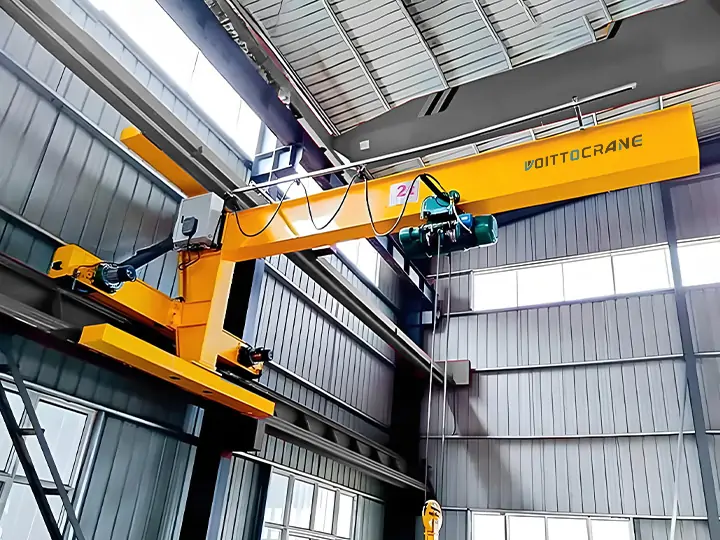

Articulating Cantilever Jib Cranes
Articulating cantilever jib cranes consist of a column, articulating structure (inner and outer booms), slewing mechanism, hoisting mechanism, and electrical system. Through the articulating movement of the boom, the equipment can be shortened to adapt to narrow spaces or extended to expand the lifting range, while still enabling rotational operations at a certain angle, depending on actual operational needs.
What is a Cantilever Jib Crane Used for?
Common industries using cantilever jib cranes include machining, assembly manufacturing, logistics, warehousing, and equipment maintenance. Users use cantilever cranes to complete material handling work in workshop workstations, production lines, warehouse shelving areas, loading and unloading areas, and maintenance workstations. They are particularly suitable for operations requiring confined spaces, repeated lifting within a small area, and material transfer between processes.
Component of Cantilever Jib Crane
A cantilever jib crane mainly consists of a column, jib, a slewing mechanism, a lifting system, and an electrical system. Below, we will introduce the floor-mounted slewing jib crane parts name and the components definition.
- Column: The main load-bearing structure of the whole machine, fixed on the ground foundation.
- Cantilever: Responsible for supporting the lifting system and defining the lifting operation range within the radius.
- Rotation Mechanism: Supports the equipment to rotate 180°, 270°, or 360°.
- Lifting System: Usually uses electric hoists or chain hoists to lift, move, and position materials.
- Electrical System: Provides power to the equipment.
- Foundation and Anchor Bolts: responsible for fixing the column to the ground foundation.

What Type of Crane is a Jib Crane?
When asking what type of crane a jib crane is, the answer comes down to its structural category and application scale. A cantilever jib crane is a type of light-duty lifting equipment. It is mainly used for lifting and moving materials within a fixed area. It covers a specified radius by rotating its jib and completes the lifting operation using an electric or manual hoist. In crane classification, it is usually categorized as a light-duty crane or a workstation crane. Compared to overhead cranes or gantry cranes, a jib crane is more compact, lower in cost, and easier to install — making it the go-to choice for localized lifting tasks.
Cantilever Jib Crane Price
| Model Type | Load Capacity (ton) | Column Length/ Lifting Height (m) | Arm Length (m) | Price (USD) |
|---|---|---|---|---|
| Floor Mounted Slewing Cantilever Jib Crane | 0.25 ~ 10 ton | 2 ~ 10 m | 2 ~ 6 m | $1000 ~ $11, 500, depending on specifications |
| Portable Jib Crane | 0.25 ~ 5 ton | 2 ~ 5 m | 2 ~ 6 m | $2000 ~ $8300, depending on specifications |
| Wall Mounted Cantilever Cranes | 0.25 ~ 2 ton | 2 ~ 12.5 m | 4 ~ 5 m | $950 ~ $3500, depending on specifications |
| Wall Travelling Jib Crane | 0.25 ~ 10 ton | 2 ~ 12.5 m | 1.5 ~ 3.5 m | $2000 ~ $12, 500, depending on specifications |
| Articulating Cantilever Jib Cranes | 0.12 ~ 2 ton | 2 ~ 5 m | 3 ~ 6 m | $1500 ~ $4200, depending on specifications |
Conclusion
As one of the most practical types of jib crane, the cantilever jib crane stands out for its flexibility and cost-efficiency. With its advantages of small footprint, low price, and easy installation, a cantilever jib crane has become the preferred solution for material handling in industrial workshops. Whether fixed, wall, or mobile, they can provide safe, precise, and continuous lifting support within a defined area, significantly improving production efficiency.
VOITTO Crane is a professional custom manufacturer and supplier of cantilever jib cranes in China. If you are looking for a flexible lifting solution suitable for your factory, our engineering team can provide professional, customized services tailored to your site environment and operating conditions. Please don’t hesitate to contact us at your convenience.


 English
  Español
  Português
  العربية
  Français
  Русский