
An electric hoist is a small lifting device that uses a reduction gear and a drum system to lift and horizontally move materials. Among them, there are many types of electric hoists, such as wire rope hoists, chain hoists, and European standard hoists, and electric hoist manufacturers can customize them according to different working environments. Next, we will introduce what is electric hoist, their applications, and prices to help you choose the right lifting solution.

CD/MD Electric Hoist

European Hoist
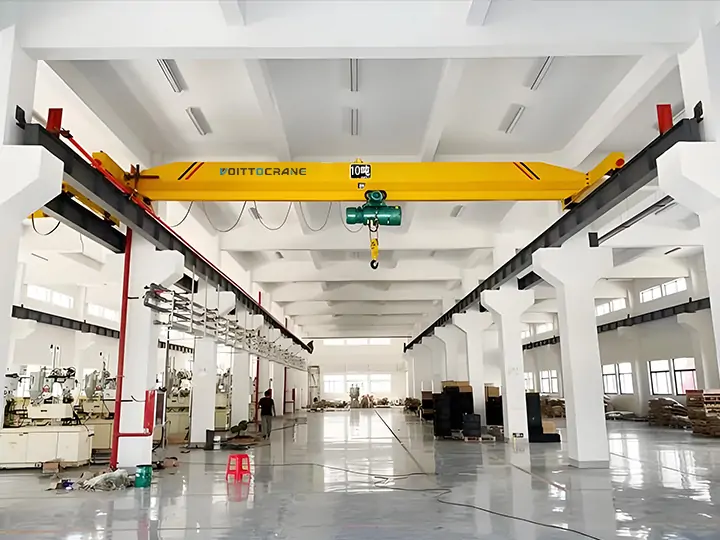
Usually, electric hoists as lifting mechanisms are equipped on overhead bridge cranes, gantry cranes, EOT cranes, jib cranes, KBK crane systems, and other equipment, and they work together to complete the lifting task.
What is a Hoists?
The electric hoist is primarily composed of a motor, reducer, drum, wire rope or chain, hook assembly, and electronic control system. The entire device features a compact structure, stable operation, and a strong load-bearing capacity, making it suitable for frequent lifting and large-tonnage material handling operations. Typically, electric hoists have a load capacity range of 1 to 32 tons. European electric hoists can reach 80 tons.

Electric Wire Rope Hoist

What is an Electric Hoist Used for?
Electric hoist operators use electric hoists, which are widely used in factories, warehouses, workshops, and construction sites to lift materials. The following are some common usage scenarios of electric hoists:
- Factories and Workshops: users use it to lift raw materials, semi-finished products, and equipment parts.
- Warehouses and Logistics Centers: When loading, unloading, stacking, and entering and leaving the warehouse, operators use electric hoists to complete the lifting and positioning of goods.
- Construction Sites: Operators use it to lift heavy construction materials such as steel bars, formwork, and concrete components.
- Machinery Manufacturing Industry: Operators use it to install, assemble, and maintain precision parts or large equipment.
- Docks and Ports: Electric hoists are equipped on gantry cranes, and users use them to load and unload containers, machinery, or bulk cargo.
- Mining and Energy Industry: In mines, power plants, wind farms, and other environments, users use it for equipment maintenance and material lifting.
- Flammable, Explosive and Dusty Environments: Users use explosion-proof electric hoists to complete lifting operations in special environments.


Electric Hoist Parts
The electric hoist consists of several components that work together to complete lifting and transport. The main components of the electric hoist include:
- Motor: The power source of the electric hoist, driving the entire lifting system.
- Reducer: responsible for reducing the speed of the motor and increasing the torque.
- Drum: Responsible for winding and unwinding the wire rope or chain.
- Wire Rope or Chain: the main load-bearing component, connected to the hook and drum.
- Hook: responsible for hanging and fixing the load, usually equipped with an anti-unhooking device.
- Brake: Automatically brake when power is off or operation stops to prevent heavy objects from sliding down.
- Electronic Control System: including control buttons, contactors, limit switches, etc.
- Traveling Mechanism: enables the electric hoist to move horizontally along the track on the main beam.
- Housing and Mounting Structure: It is responsible for supporting and protecting internal components.

How Does an Electric Hoist Work?
The operator controls the electric hoist through buttons or a remote control. The electric hoist uses an electric motor as the power source, and the reduction device converts high-speed rotation into low-speed, large-torque motion, driving the drum to rotate, completing the reeling and releasing movement of the wire rope or chain, and driving the hook to lift and move heavy objects. The entire equipment is equipped with brakes, limiters, and overload protection devices, and has the characteristics of safe and reliable operation.Knowing what’s inside the unit is one thing — matching those components to your actual load, lift height, duty class, and operating environment is where most procurement mistakes happen. The five factors that determine whether a hoist performs reliably over its full service life are covered step by step in this electric hoist selection guide.
Electric Hoist Specification
| Model Name | Electric Hoist |
|---|---|
| Lifting Capacity | 1-32 Ton |
| Lifting Height | 6-48 Meter |
| Hoisting Lifting Speed | 8/0.8 M/MIN |
| Hoisting Travelling Speed | 20/ 30 M/MIN |
| Working Class | M3 |
| Ambient Temperature | -25℃ to 40℃ |
| Power Source | Three-phase AC, 380V, 50Hz |
| Maximum Self-weight | 3270 kg |
Electric Hoist Price
The electric hoist price varies depending on specific configurations such as lifting height, load capacity, material type, control method, and additional safety features. Below, we have listed some sample prices for reference only — the final quotation will be tailored to your exact requirements.
| Load Capacity | Lifting Height | Price Range (USD) |
|---|---|---|
| Electric Hoist 1 Ton | 6-18 Meter | 290~390 USD |
| Electric Hoist 2 Ton | 6-18 Meter | 350~650 USD |
| Electric Hoist 3 Ton | 6-18 Meter | 600~800 USD |
| Electric Hoist 5 Ton | 6-30 Meter | 900~1025 USD |
| Electric Hoist 10 Ton | 6-48 Meter | 1350~2400 USD |
| Electric Hoist 15 Ton | 6-48 Meter | 1750~2900 USD |
| Electric Hoist 20 Ton | 6-48 Meter | 3300~4700 USD |
| Electric Hoist 32 Ton | 6-48 Meter | 4500~6450 USD |
Conclusion
The above content introduces what is electric hoist, its application and price, etc. Electric hoists have become the preferred solution for heavy material handling due to their compact structure, easy operation, strong load-bearing capacity, safety and reliability.
VOITTO, a professional electric hoist manufacturer and supplier in China. committed to providing customers with efficient solutions. If you need electric hoist equipment or customized solutions, please feel free to contact us.

Alan
Crane Solutions Specialist · Voitto Crane
Specialized in Overhead Crane, Gantry Crane, Jib Crane, Port Crane & EOT Crane export solutions. 10+ years helping global clients with pre-sales consultation, capacity selection and site-specific configurations.




 English
  Español
  Português
  العربية
  Français
  Русский