Introduction
In workshops, warehouses, and small manufacturing facilities, selecting the right light-duty overhead crane is essential for ensuring safe, efficient, and cost-effective material handling. With a wide range of options available, including lifting capacity, span, mounting methods, and control systems, choosing the most suitable crane requires a thorough understanding of your specific operational needs and work environment.
In this guide, we will walk you through the key factors to consider when selecting a light-duty overhead crane, including load requirements, workspace constraints, customization options, and safety features, to help you make an informed decision that maximizes productivity while minimizing long-term costs.
What Is a Light Duty Overhead Crane?
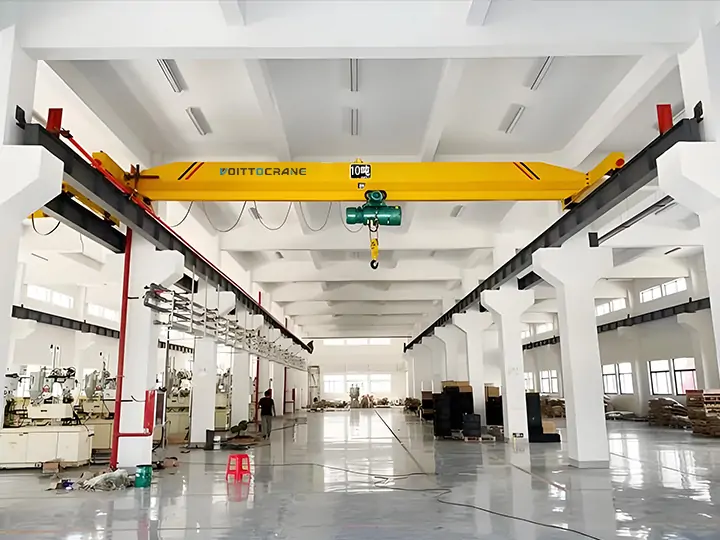
A light duty overhead crane, also called a small overhead crane, which is a compact bridge crane system designed for lifting and moving relatively light loads, typically within a range of 0.5 to 10 tons—in confined or low-intensity working environments. It runs on overhead beams or tracks and is usually equipped with an electric hoist for smooth, controlled operation. Known for its simple structure, flexibility, and cost efficiency, this type of crane is widely used in workshops, maintenance areas, and small-scale production lines where frequent but moderate lifting is required.
Before committing to a light-duty specification, it’s worth understanding how it differs from a lightweight overhead crane — the two terms are frequently confused. Our lightweight vs light duty overhead crane comparison covers the structural, duty-class, and cost differences in detail.


Components
The equipment consists of the main girder, end beams, hoisting mechanism, trolley, traveling mechanism, rails, control system, and safety devices. These components work together to ensure safe and efficient material handling. Below are the primary functions of each component:

Main Girder: The crane’s core load-bearing structure.
End Beams: Support the main girder and enable the crane’s overall operation.
Hoisting Mechanism: The core component for lifting and lowering loads.
Trolley Mechanism: Moves along the main girder and coordinates with the bridge movement to position the load.
Travel Mechanism: Drives the crane along the rails, ensuring smooth operation and precise positioning.
Rail System: The crane’s foundational support structure, determining its travel path and working range.
Electrical Control System: Controls the crane’s hoisting, travel, and stopping operations.
Safety Devices: Prevent equipment overload, overtravel, or misoperation, enhancing overall safety.
Types of Overhead Light Duty Cranes
Different application scenarios have diverse requirements for equipment structure and performance. As a professional manufacturer of light-duty gantry cranes, VOITTO offers a variety of crane solutions to meet the operational needs of various industries, including warehousing, assembly, and logistics. Let’s take a brief look at the available types.
Single-Girder Overhead Crane
A single-girder overhead crane is a widely used lifting solution designed with one main beam supporting the hoist system. It is typically applied in light to medium-duty material handling operations, offering an efficient and cost-effective way to lift and transport loads within workshops, warehouses, and production facilities.


| Item | Content |
| Features | With a single main beam, simple structure, low manufacturing and installation costs |
| Application Scenarios | Light material handling, component assembly, and warehouse cargo handling |
| Advantages | Small space occupation, flexible operation, suitable for medium and light loads |
Double-girder Overhead Cranes
Featuring a double-girder structure, these are suitable for long-span applications requiring high load capacity, stability, and precision.


| Item | Content |
| Features | Double main beam structure, higher load capacity and suitable for large spans |
| Application Scenarios | Heavy material handling, large mechanical assembly and production lines |
| Advantages | Large lifting capacity, high stability and suitable for heavy duty working environments |
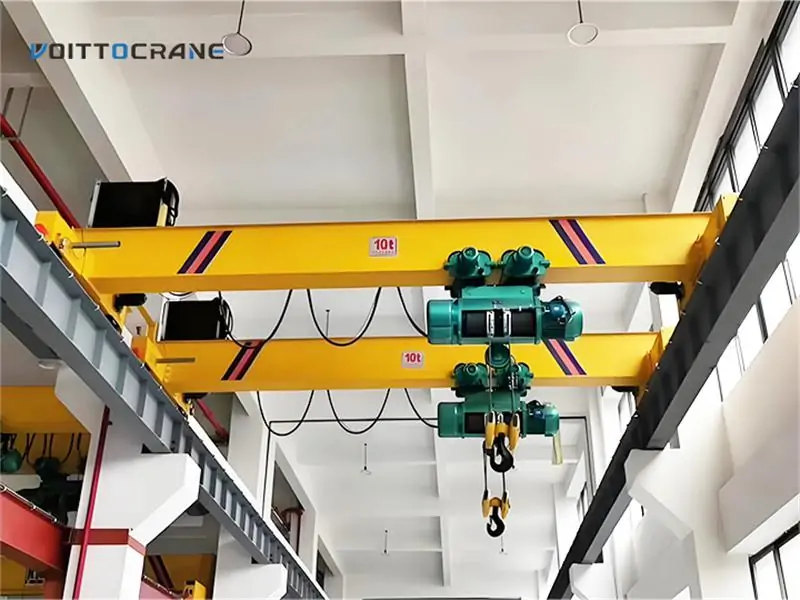
Electric Hoist Bridge Crane
Features an electric hoist as the core lifting mechanism, offering simple operation and high efficiency, suitable for precise lifting operations.

| Item | Content |
| Features | Equipped with an electric hoist for precise lifting and movement |
| Application Scenarios | Assembly workshops, warehouse logistics, light-duty handling |
| Advantages | Easy operation, high efficiency and precise positioning |
KBK Light-Duty Overhead Crane:
With an electric hoist as the core lifting mechanism, it offers simple operation and high efficiency, making it suitable for precise lifting operations.


| Item | Description |
| Features | Modular combined structure design with flexible assembly |
| Application Scenarios | Production lines, mechanical processing workshops, warehousing and logistics, electronic manufacturing |
| Advantages | High flexibility, stable operation, low noise and low cost |
Case Study
In October 2023, VOITTO received an inquiry from a recycled paper mill in the Philippines processing around 30 tons of waste paper per day. The client faced operational inefficiencies caused by forklift congestion, high manual handling costs, and material losses of 8%–10% due to spillage. They planned to install an LD-type 5-ton single-girder electric overhead crane with an electromagnetic gripper to improve material handling efficiency.
Their workshop presented several challenges, including a limited 12-meter span, restricted load-bearing capacity, high humidity (65%–70%), heavy dust conditions, and limited operator experience. To address these issues, VOITTO delivered a customized lightweight crane solution with 25% reduced dead weight, an IP65-rated electromagnetic gripper, anti-rust coating, and a sealed dust-proof structure, combined with a simplified wireless remote control system to ensure reliable, efficient, and user-friendly operation in harsh working conditions.


Key Factors to Consider When Choosing a Light Duty Overhead Crane
When selecting a light-duty overhead crane, it is essential to evaluate equipment performance, operational efficiency, and safety in conjunction with actual working conditions. Below are several key selection factors:
Lifting Capacity:
Lifting capacity is a core parameter. It should be selected based on the maximum weight of the actual load, with a safety margin (typically 10%–25%) factored in.
Span:
Span refers to the distance between the rails at both ends of the crane’s main girder. This distance determines the equipment’s coverage area and should be customized based on the width of the facility or the dimensions of the work area to meet overall material handling needs.
Lifting Height:
Lifting height refers to the maximum vertical travel distance of the hook. It should be selected based on the facility’s ceiling height, equipment dimensions, and stacking requirements.
Operating Environment:
Different environments impose varying requirements on the equipment; environmental factors directly influence material selection and safety configurations. (e.g., indoor/outdoor; high-temperature, dusty, or corrosive environments; explosion-proof requirements, etc.)
Installation Method:
Light-duty overhead cranes come in two types: supported and suspended. The installation method is determined based on the factory structure (i.e., whether load-bearing beams are present).
Power Supply and Control Methods:
To enhance operational efficiency and safety, select appropriate power supply and control methods. (Power supply: 220V / 380V / custom voltage; Control methods: push-button control / wireless remote control.)
Safety Features:
Equipped with overload protectors, limit switches, and emergency stop buttons to reduce the risk of accidents.
Customization:
We design lightweight bridge cranes tailored to specific operational scenarios through non-standard lifting capacities or spans, as well as designs for special working environments.
The selection of suitable lifting equipment requires a comprehensive assessment of four key factors, lifting capacity, span, lifting height, and working environment, along with usage frequency and safety requirements. Reducing long-term operating costs while improving operational efficiency is also a critical factor for businesses to consider.
Light Duty Overhead Crane vs Other Crane Types
Many companies compare light-duty overhead cranes with other types of lifting equipment. Different types of cranes vary significantly in terms of structure, flexibility, and applications. The table below provides a professional comparative analysis.
| Type | Installation Method | Mobility | Lifting Capacity | Application Scenarios | Advantages |
| Light Bridge Crane | Fixed rails (above the factory) | Low | 0.5–10 tons | Workshops, warehouses | Stable, efficient, wide coverage |
| Gantry Crane | Ground-supported | High | 0.5–50 tons+ | Outdoor areas, warehouses | Movable, no factory structure required |
| Jib Crane | Fixed column / wall-mounted | Low | 0.25–5 tons | Station operation | Low cost, localized coverage |
| Mobile Crane | Mounted on vehicle chassis | Very high | 5–500 tons+ | Engineering construction | Extremely flexible |
| Portal Crane | Rail-mounted on the ground | Medium | 10–100 tons+ | Ports, storage yards | Large span, heavy lifting capacity |
Safety Precautions
- 1. Personnel must undergo professional training and strictly follow operating procedures.
- 2. Inspect the condition of the equipment regularly.
- 3. Strictly adhere to the crane’s rated lifting capacity.
- 4. Do not operate the crane in harsh environments.
- 5. Conduct regular safety drills.
- 6. Keep the work area clean.
- 7. Post warning signs in the crane operating area and provide safety equipment.
Equipment Maintenance
1. Perform regular inspections and maintenance.
2. Before use, inspect the wire ropes and hooks for safety; replace them immediately if any issues are found.
3. Regularly inspect the wear on brakes, brake discs, and brake linings.
4. Inspect the rails and travel wheels.
5. Apply anti-corrosion protection to prevent corrosion.
6. Conduct regular comprehensive inspections.
FAQ
1. What is a light-duty overhead crane?
A light-duty overhead crane is a lifting system designed for handling loads typically between 0.5 to 10 tons in workshops and warehouses.
2. What capacity do I need?
You should choose a crane capacity slightly higher than your maximum lifting requirement, usually with a 10–25% safety margin.
3. How much does it cost?
The cost varies depending on capacity, span, configuration, and customization requirements.
4. Can it be customized?
Yes, light-duty overhead cranes can be fully customized based on lifting capacity, span, height, and working conditions.
5. What is the installation time?
Installation typically takes a few days to a couple of weeks, depending on project complexity and site conditions.
6. What industries use light-duty overhead cranes?
They are widely used in manufacturing, warehousing, maintenance, and assembly operations.
7. What type of hoist is best for a light-duty overhead crane?
Electric chain hoists are commonly used for light-duty applications due to their efficiency and ease of operation.
8. Is a light-duty overhead crane suitable for small workshops?
Yes, it is ideal for small workshops due to its compact structure and space-saving design.
Summary
With their flexible structure, compact footprint, and high efficiency and safety, light-duty overhead cranes have become the ideal material handling solution for warehousing and logistics, production workshops, and assembly operations. From equipment selection and parameter matching to daily maintenance and safety management, these factors directly impact overall operational efficiency and service life. VOITTO Crane has provided solutions to over 80 countries and regions worldwide, delivering nearly 40,000 units of equipment. With ISO and CE certifications, we ensure every unit meets the highest international standards. If you have any questions regarding equipment selection, please contact us.

Alan
Crane Solutions Specialist · Voitto Crane
Specialized in Overhead Crane, Gantry Crane, Jib Crane, Port Crane & EOT Crane export solutions. 10+ years helping global clients with pre-sales consultation, capacity selection and site-specific configurations.




 English
  Español
  Português
  العربية
  Français
  Русский