
An electric hoist with remote gives your team motorized lifting plus hands-free distance control in a single unit. Entry-level 110V models for garages and light workshops start around $80–$300; industrial-grade 3–10 ton chain hoists with CE-certified wireless pendants run $800–$3,000; heavy-duty wire rope hoists for overhead cranes reach $1,900–$3,000+ (market reference, ex-works). If you’re comparing options for a factory, warehouse, or workshop, this guide walks you through exactly what to specify — before you talk to a supplier.
Most buyers waste time comparing lifting capacities alone. The real variables are remote type, duty class, and installation constraints. Get those wrong and you’ll either overbuy on budget or watch an undersized hoist fail during a busy production shift.
This guide covers: the two main hoist types, wired versus wireless remote trade-offs, the four key specs that actually determine fit, pricing by category, and the certification checks that protect you from non-compliant equipment.
- 1 Quick Reference: Electric Hoist with Remote — Pricing & Specs by Category
- 2 1. Chain Hoist vs Wire Rope Hoist: Which Type Fits Your Job?
- 3 2. Wired Pendant vs Wireless Remote: A Technical Comparison
- 4 3. The Four Specs That Actually Determine Fit
- 5 4. Certifications: What to Check Before You Buy
- 6 Conclusion
-
7
FAQ
- 7.1 Q1: What is a safe working load (SWL) and how does it differ from the hoist’s rated capacity?
- 7.2 Q2: How far does a wireless remote control work on an electric hoist?
- 7.3 Q3: Can I use a 110V electric hoist with remote in a commercial workshop?
- 7.4 Q4: What certifications should I require when buying an electric hoist for a factory?
Quick Reference: Electric Hoist with Remote — Pricing & Specs by Category
| Category | Capacity | Remote Type | Typical Use | Price Range (Market Ref.) |
|---|---|---|---|---|
| Light-duty wire rope hoist | 440–880 lbs | Wired or wireless | Garage, attic, small workshop | $100–$300 |
| Mid-range chain hoist | 0.5–2 ton | Wireless (CE) | Auto repair, fabrication, warehouse | $300–$500 |
| Industrial chain hoist | 3–5 ton | Wireless 8/12-key | Manufacturing, shipbuilding, maintenance | $300–$1,000 |
| Wire rope hoist | 5–10 ton | Wireless + VFD option | Overhead cranes, heavy industry | $450–$3,000+ |
| Explosion-proof hoist | 0.5–10 ton | Ex-rated wireless | Chemical plants, fuel storage | $350–$2,500+ |
1. Chain Hoist vs Wire Rope Hoist: Which Type Fits Your Job?

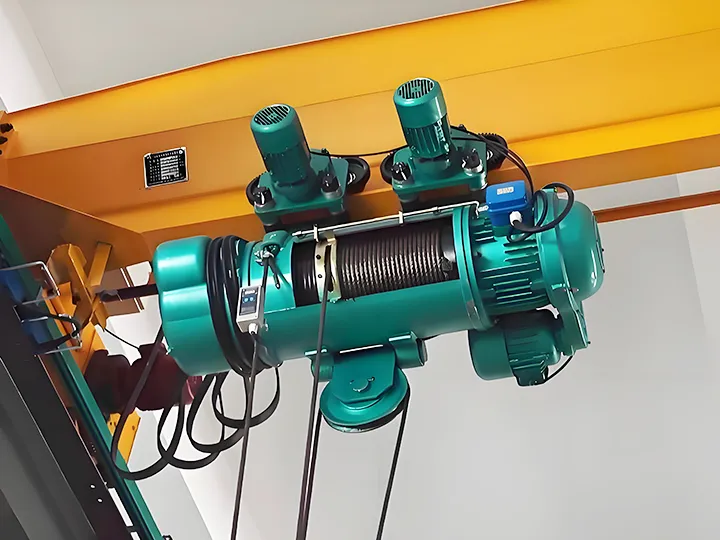
Electric Chain Hoist: Compact, Versatile, Under 5 Tons
An electric chain hoist is the right choice for loads from 0.5 to 5 tons where headroom is limited and the duty cycle is moderate. The lifting mechanism uses a high-strength steel load chain (typically Grade 80 or Grade 100 per EN 818-7), which is compact enough to pocket into a small chain bag rather than spooling on a drum. This makes chain hoists significantly shorter in overall height — critical when your beam clearance is under 3 meters.
Chain hoists handle repetitive lifts well at moderate frequencies. Under FEM 1.001 classification, most catalog units are rated M3 or M4 duty class — suitable for roughly 2–4 hours of lifting per 8-hour shift. Auto repair shops, small fabrication units, and warehouse loading bays are the natural home for this type.
Typical specs: 0.5–20 ton capacity, lift heights to 30 m, motor power 0.4–7.5 kW, lifting speed 2–8 m/min.
Electric Wire Rope Hoist: Precision and Heavy Cycles Above 5 Tons


A wire rope hoist wraps a multi-strand steel cable around a grooved drum. This design allows longer lift heights (up to 60 m+), smoother load positioning, and higher duty cycles — typically M5 or M6 under FEM 1.001, supporting continuous industrial use. Wire rope hoists are the standard specification for overhead bridge cranes and gantry crane systems where loads exceed 3–5 tons or where the hoist runs multiple shifts per day.
The tradeoff is size and cost: wire rope units are physically larger, heavier, and require more headroom. For anything under 5 tons in a standard industrial setting, a chain hoist will serve you better at half the price.
Typical specs: 1–32 ton capacity, lift heights to 60 m+, motor power 1.5–22 kW, variable speed available via VFD.
Selection rule: If your load is under 5 tons, headroom is tight, and duty is moderate — specify an electric chain hoist with remote. If you’re running a crane system, lifting more than 5 tons, or running more than 6 hours of daily lifting — specify a wire rope hoist.
2. Wired Pendant vs Wireless Remote: A Technical Comparison
Wired Pendant Control: Reliable in Interference-Heavy Environments
A wired pendant connects directly to the hoist control panel via a cable — typically 5 to 15 meters long. Signal transmission is instantaneous and immune to radio frequency interference, which matters in environments with welding equipment, large motors, or dense metal shielding. There are no batteries to replace and no pairing process to manage.
The limitation is operator mobility. The pendant tethers you to a fixed radius around the hoist. In tightly enclosed cells or where the operator’s position doesn’t change, this is a non-issue. In large warehouses or where the operator needs to guide a load from multiple positions, it creates a genuine safety constraint.
Wireless Remote Control: Standard for Industrial Sites
A wireless remote operates via 433 MHz or 2.4 GHz radio signal, with standard control distances of 50–100 meters (line of sight). The operator moves freely, maintains full visual contact with the load from any angle, and keeps clear of the lift zone — a meaningful safety upgrade over a tethered pendant.
CE-certified wireless remotes (per EN 60068-2 environmental standards) should include a dedicated emergency stop button, low-battery indicator, and anti-interference frequency hopping. Industrial-grade units offer 8-key layouts (up/down, left/right travel, emergency stop) and 12-key layouts that add speed selection or cross-travel.
One practical note: In environments with dense 2.4 GHz traffic (crowded Wi-Fi, Bluetooth devices), opt for 433 MHz systems or units with frequency-hopping spread spectrum (FHSS) to avoid signal dropout.
| Feature | Wired Pendant | Wireless Remote |
|---|---|---|
| Signal reliability | Excellent (no interference) | Good (FHSS models) |
| Operator mobility | Limited (cable length) | Full freedom |
| Control distance | 5–15 m | 50–100 m |
| Battery required | No | Yes (replaceable) |
| Best for | Fixed workstations, welding bays | Large warehouses, open sites |
| Cost premium over base | Minimal | $50–$300 additional |
For most factory and warehouse applications, wireless remote control is the better default — the mobility and safety advantages outweigh the minor battery management overhead.
Get Quote
3. The Four Specs That Actually Determine Fit
Lifting Capacity: Apply a Safety Margin
Never spec a hoist at exactly your maximum load. The standard practice is to select a unit rated at 125% of your working load limit (WLL) — consistent with ASME B30.16 for overhead hoists. If your heaviest lift is 1,000 lbs, specify a 1,320 lb (0.6 ton) or 2,000 lb (1 ton) unit. This margin accounts for dynamic load factors and prevents operating at the limit of the mechanical components.
Duty Class: The Spec Most Buyers Ignore
Lifting capacity tells you the maximum weight. Duty class tells you how often the hoist can lift it. Under the FEM 1.001 classification system (also referenced in ISO 4301/1):
- M3 — light use, up to ~1.6 hours lifting per shift
- M4 — moderate use, 1.6–3.2 hours per shift
- M5 — heavy use, 3.2–6.3 hours per shift
- M6 — very heavy industrial, continuous production environments
Catalog hoists sold on Amazon or general retail are typically M3. If your team runs the hoist more than 2–3 hours per shift, you need a purpose-built industrial unit rated M4 or higher — or you will be replacing the hoist within 12–18 months.
Lifting Height and Speed
Lifting height determines how much wire rope or chain you need on the drum. For a 6-meter ceiling, a unit rated to 8–10 m effective lift is comfortable. Speed is a productivity variable: most standard chain hoists lift at 2–5 m/min; wire rope hoists with VFD control can offer 1–10 m/min variable speed, which is useful when precise load placement is required.
Power Supply: 110V vs 220V vs 3-Phase 380V/440V
- 110V single-phase: Standard North American household current. Suits garage and light workshop hoists up to approximately 880 lbs.
- 220V single-phase: Common for larger garage setups and light industrial. Supports units up to approximately 1 ton.
- 3-phase 380V / 440V: Required for industrial-grade hoists above 1 ton and any wire rope hoist on an overhead crane system. Confirm your site power before specifying.
4. Certifications: What to Check Before You Buy
CE Marking (EN 14492-2)
The CE mark on an electric hoist indicates the manufacturer has declared conformity with EU Machinery Directive 2006/42/EC. For hoists, the specific harmonized standard is EN 14492-2:2006+A1:2009 (Power driven winches and hoists). A CE mark without a Declaration of Conformity document is not sufficient — always request the DoC, which should name the notified body and the specific standards assessed.
ASME B30.16
For North American industrial installations, ASME B30.16 (Overhead Hoists — Underhung) defines safety requirements for design, installation, inspection, and operation. If your site operates under OSHA regulations, verify that the hoist’s design basis references ASME B30.16 or the equivalent.
ETL and UL Listings
For 110V/120V garage and workshop units in North America, ETL or UL listing confirms that the product has been tested to recognized safety standards for the consumer market. This is the minimum certification to accept for any unit going into a commercial workspace.
Supplier check: Request a copy of the CE Declaration of Conformity and the load test certificate. Reputable manufacturers include actual load test records with each shipment. If a supplier cannot produce these documents, treat it as a disqualifying issue.
Conclusion
Choosing the right electric hoist with remote comes down to three decisions made in sequence: type (chain or wire rope), remote configuration (wired pendant or wireless), and duty class (matched to your actual daily usage hours). Get these right and the capacity and price will follow naturally from the spec.
For loads under 5 tons in a standard industrial or workshop environment, an electric chain hoist with wireless remote — CE-certified, rated M4 or above for shift work — covers the majority of applications at $400–$3,500. For overhead crane systems or heavy continuous use, step up to a wire rope hoist and verify the FEM duty class in writing before ordering.
If you have site-specific requirements — low headroom, explosion-proof rating, VFD speed control, or long-range wireless for large facilities — contact our engineering team with your load, height, duty cycle, and power supply details. We’ll configure the right unit and provide a formal quotation.

Alan
Crane Solutions Specialist · Voitto Crane
Specialized in Overhead Crane, Gantry Crane, Jib Crane, Port Crane & EOT Crane export solutions. 10+ years helping global clients with pre-sales consultation, capacity selection and site-specific configurations.
FAQ
Q1: What is a safe working load (SWL) and how does it differ from the hoist’s rated capacity?
Rated capacity is the maximum load the hoist is designed to lift under controlled test conditions. Safe Working Load (SWL) is the load you should actually use in daily operations — typically 80% of rated capacity for repeated lifts, accounting for dynamic forces per ASME B30.16. A 1-ton rated hoist should be operated with a practical SWL of 800 kg for regular production lifts. Never use rated capacity as your planning number.
Q2: How far does a wireless remote control work on an electric hoist?
Standard wireless remotes operate up to 50–100 meters line-of-sight, using 433 MHz or 2.4 GHz frequencies. Industrial units with FHSS (frequency-hopping spread spectrum) maintain reliable signal in congested RF environments such as busy factory floors. Range drops significantly when there are metal walls, large machinery, or multiple wireless devices competing on the same band. For facilities larger than 5,000 m², confirm the remote’s operating frequency and ask for FHSS certification.
Q3: Can I use a 110V electric hoist with remote in a commercial workshop?
Yes, but with practical limits. A 110V single-phase hoist typically maxes out at 440–880 lbs (200–400 kg) of reliable working capacity and is rated for light-duty use (FEM M3). For commercial workshops where the hoist operates more than 2 hours per shift, or where loads regularly exceed 500 lbs, a 3-phase 380V or 440V industrial unit rated M4 or M5 is the correct specification. Running a consumer-grade 110V hoist in a production environment will shorten its service life significantly.
Q4: What certifications should I require when buying an electric hoist for a factory?
For EU markets: CE marking with Declaration of Conformity referencing EN 14492-2. For North American markets: compliance with ASME B30.16 and, for 110V models, an ETL or UL listing. For hazardous environments (chemical plants, fuel storage): require ATEX certification (Directive 2014/34/EU) for EU, or NEC Class I Division 2 certification for North American sites. Always request the load test certificate — this document confirms the specific unit was physically tested before dispatch, not just the model series.


 English
  Español
  Português
  العربية
  Français
  Русский