
Industrial winch manufacturers in China supply the lifting mechanism units fitted to overhead cranes, gantry cranes, and port cranes. Industrial winches designed specifically for cranes integrate a wire rope drum, a multi-stage gearbox, a hoisting motor, and a mechanical braking system into a single unit. They are engineered specifically for repetitive vertical load cycles under specific duty cycles. Their rated load, thermal capacity, and safety device specifications are determined based on the crane’s specific operating parameters, rather than simply applying standard data from product catalogs.


China accounts for the largest share of global crane-grade winch production. Manufacturing is concentrated in Henan Province, with additional clusters in Shanghai, Jiangsu, Liaoning, and Hunan. The ten manufacturers listed below have documented crane-specific winch product lines that cover electric and hydraulic winch systems, as well as custom-engineered configurations for non-standard crane applications.
What Separates a Crane-Grade Industrial Winch from General Winches
Industrial winches for cranes are specifically designed for vertical lifting and material handling applications that demand the highest levels of safety, precision, and continuous operational reliability. In contrast, standard winches are typically used for horizontal pulling or towing operations. Below, I will outline the key differences between the two.

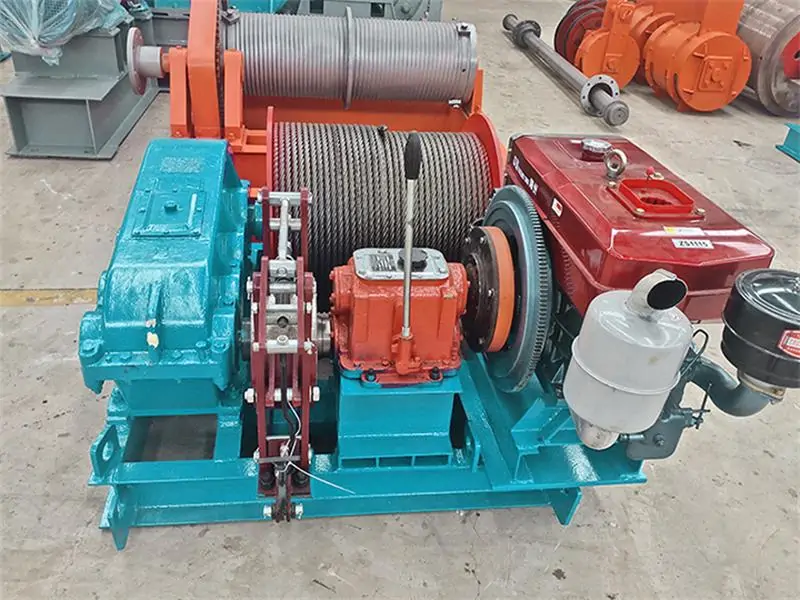
Hydraulic Winch

Electric Winch
Duty Classification — the Parameter Most Often Ignored at Procurement
A crane winch has specific “duty cycle” ratings. This is a comprehensive indicator that measures their daily operating hours and average load factor over the entire duty cycle. The duty cycle directly determines the selection of the motor’s thermal capacity, the service life of the gearbox, and the wear rate of the brake. If a winch has sufficient rated load capacity but an inadequate duty cycle, it will gradually fail due to thermal degradation during repeated lifting cycles. This failure does not result from a single, obvious overload incident. Because of this failure mode, selecting a winch based solely on the rated load is far from sufficient.
Safety Device Integration — Minimum Requirements for Crane Service
Industrial winch systems for crane applications must be equipped with load limiters, upper and lower travel limit switches, and brakes. Applications involving port cranes and metallurgical cranes typically require redundant braking systems—that is, systems comprising two independent braking circuits, each of which must be capable of handling the rated load.
Note: Crane winch purchasing personnel must ensure that each safety device has been individually tested and documented, rather than merely listed in the hoist’s technical specifications. A mere statement that a device is “included” without corresponding test records has no probative value for compliance verification.
Top 10 Industrial Winch Manufacturers in China
The table covers manufacturers with confirmed crane winch product lines. Winch type designations reflect primary catalog offerings. Most suppliers accommodate non-standard configurations on a project basis.
| No. | Manufacturer | Location | Winch Types | Crane Applications |
| 1 | VOITTO Crane | Henan | Electric, Hydraulic, Custom | EOT Crane, Gantry, Electric Hoist |
| 2 | WEIHUA Group | Henan | Electric, Hydraulic, Custom | Overhead, Gantry, Port crane |
| 3 | NUCLEON Crane | Henan | Electric, Variable-speed | Bridge crane, EOT crane |
| 4 | ZPMC | Shanghai | Hydraulic, High-capacity | Port crane, Ship-to-shore crane |
| 5 | Henan Mine Crane | Henan | Electric, Explosion-proof | Metallurgical, Mining crane |
| 6 | Jiangsu JIALIFT | Jiangsu | Electric, Hydraulic | Gantry crane, Port crane |
| 7 | TOLIAN Heavy Industry | Liaoning | Hydraulic, Custom | Marine crane, Offshore crane |
| 8 | SANY Hoisting | Hunan | Hydraulic, Variable-speed | Tower crane, Mobile crane |
| 9 | Anqing Shengyuan | Anhui | Electric, Explosion-proof, Custom | Overhead crane, Hoist systems |
| 10 | Hebei Liba | Hebei | Electric, Compact | Gantry crane, Overhead crane |
Manufacturer Profiles: Technical Differentiators by Application
1. VOITTO Crane — Custom Industrial Winch System Engineering
VOITTO Cranes operates as a custom winch manufacturer and supplier, handling non-standard load ratings, non-standard drum geometry, and variable-speed drive integration as standard project scope. They supply both electric and hydraulic winch systems and can deliver CE marking documentation packages for export to regulated markets. This makes VOITTOCrane a practical option when the required winch specification falls outside the catalog range of standard electric or hydraulic winch manufacturers.
2. WEIHUA Group — Integrated Electric and Hydraulic Winch Systems
WEIHUA manufactures crane winches as a core product line within an integrated crane manufacturing operation, not as a sourced component. This means interface dimensions, electrical compatibility, and load-test traceability are controlled within the same engineering organization. Their range covers electric hoisting winches from 1 tonne to over 500 tonnes, with hydraulic variants for port and shipbuilding crane applications. CE and ISO documentation is available for export orders. For procurement of a complete industrial winch system — including control integration — WEIHUA offers a single-source supply chain that reduces interface coordination risk.
3. NUCLEON Crane — Standard Electric Winches for Bridge Crane Applications
NUCLEON’s winch products are developed and optimized for standard electric overhead traveling (EOT) crane configurations: fixed installation, standard voltage supply, moderate duty classification, and compatibility with their proprietary crane control systems. For standard warehouse or workshop overhead crane replacements, NUCLEON offers competitive lead times and well-documented electrical interface specifications.
4. ZPMC — High-Capacity Hydraulic Winches for Port and Marine Cranes
Shanghai Zhenhua Heavy Industries designs hydraulic winch systems as components within their port crane and shipbuilding crane product lines. Winches for container cranes, ship-to-shore cranes, and floating crane systems are developed to high-cycle port duty requirements. ZPMC does not typically supply winches as standalone products; procurement of their assemblies is generally tied to complete crane system orders or major maintenance and repair contracts with established port operators.
5. Henan Mine Crane — Explosion-Proof and Metallurgical Winch Systems
For crane applications in explosive atmospheres, high-radiant-heat environments, or molten metal handling facilities, Henan Mine Crane produces winches to explosion-proof and heat-resistant specifications. Explosion-proof ratings require explicit documentation of the protection concept — Ex d (flameproof enclosure), Ex e (increased safety), or others — and the applicable equipment category. Confirm that the protection concept matches the zone classification of the installation site, not just the general label “explosion-proof.”
6. Jiangsu JIALIFT — Mid-Range Electric and Hydraulic Winches for Port and Gantry Cranes
JIALIFT has a stronger commercial export presence than deep technical customization. Their electric and hydraulic winch product lines cover standard port and gantry crane applications, with documented export to Southeast Asian and Middle Eastern markets. Suitable for applications where standard catalog specifications are acceptable and delivery lead time is a priority factor.
7. TOLIAN Heavy Industry — Marine and Offshore Crane Hydraulic Winches
TOLIAN specializes in marine and offshore crane applications, including deck crane and floating crane configurations. Their hydraulic winch systems are designed for saltwater-environment corrosion resistance and high-torque, low-speed operation characteristic of offshore lifting. For land-based overhead crane applications, TOLIAN is not the primary choice. Its engineering focus and documentation packages are oriented toward marine classification society requirements.
8. SANY Hoisting — Hydraulic Winches for Mobile and Tower Cranes
SANY Hoisting’s winch products are developed within their mobile crane and tower crane product lines. Their hydraulic winch systems are optimized for variable-load construction applications rather than fixed-installation industrial cranes. For bridge crane or gantry crane applications requiring continuous-duty electric drive, SANY’s product range is not the primary fit.
9. Anqing Shengyuan — Custom Explosion-Proof Electric Winch Systems
Anqing Shengyuan covers custom electric winch engineering for hoist applications, including explosion-proof configurations and non-standard duty specifications. Their product range overlaps with Henan Mine Crane in explosion-proof applications but extends to custom hoist system integration beyond standard crane winch configurations.
10. Hebei Liba — Compact Electric Winches for Light-Duty Overhead and Gantry Cranes
Hebei Liba produces compact electric winches suited to light-duty overhead crane and gantry crane applications. Their product range is catalog-based with a limited customization scope. Appropriate for standard low-capacity crane replacements where budget and delivery time are the primary selection criteria.
Crane Winch Procurement: Parameters That Fail Under Real Operating Conditions
The most common mistake procurement personnel make when purchasing from Chinese industrial winch manufacturers is to use “rated load” as the primary selection criterion. While rated load is certainly a necessary condition, it is by no means a sufficient one. The key parameters that truly determine whether an industrial winch system can operate trouble-free under actual crane operating conditions include the duty class, thermal rating, and the compatibility between the wire rope and the drum—none of which appear on standard product nameplates.
| Parameter | Required Document | Common Gap If Missing |
|---|---|---|
| Duty Class / Working Group | ISO 4301 / FEM classification document | Winch rated only to the nameplate load with no duty documentation |
| Thermal Rating | Motor thermal class certificate at stated duty | Load rating adequate, motor overheats under repeated cycles |
| Rope & Drum Compatibility | Drum capacity drawing: diameter, length, layers | Rope pile-up or fleet angle error post-installation |
| Safety Device Specification | Limit switch test report, brake test certificate | Safety devices listed in spec but not individually tested |
| Certification Package | DoC, CE certificate (if required), test protocol | Generic product-family certificate, model not specified |
A second structural error is accepting rope and drum specifications as a single line item (e.g., “6×37 IWRC wire rope”) without confirming drum capacity at the required rope length and maximum reeving layer. Mismatched drum capacity causes rope pile-up and adverse fleet angle after installation — a correction that requires winch replacement or drum extension, both expensive post-installation interventions.
Industrial Crane Winch for Sale – VOITTO Crane
VOITTO Crane is dedicated to designing and manufacturing industrial winch systems specifically for bridge cranes, gantry cranes, and port cranes. Products are shipped directly from the factory to project sites across Europe, the Middle East, Southeast Asia, and North America.
Every VOITTO winch is manufactured in strict accordance with established Duty Class standards and comes with a complete set of certification documents compliant with CE, ISO, and FEM specifications. If the specifications in the standard product catalog do not meet specific project requirements, VOITTO’s engineering team will provide customized solutions tailored to the customer’s lifting needs. If you need a crane winch solution, please feel free to contact us at any time.

Alan
Crane Solutions Specialist · Voitto Crane
Specialized in Overhead Crane, Gantry Crane, Jib Crane, Port Crane & EOT Crane export solutions. 10+ years helping global clients with pre-sales consultation, capacity selection and site-specific configurations.
FAQ
What is a crane-grade industrial winch, and how does it differ from a standard winch?
A crane-grade industrial winch is an engineered hoisting drive unit designed for repetitive vertical load cycles under a defined duty classification. Standard or general-purpose winches are rated for static or intermittent horizontal pulling loads. The differences are structural: crane winches require duty class documentation, fail-safe braking certified to rated load, travel limit switches, and thermal sizing matched to the crane’s operating pattern. Using a non-crane-rated winch in a crane hoisting application does not meet the structural or safety requirements of crane standards and creates liability exposure.
How do I choose between electric winch manufacturers and hydraulic winch manufacturers for a crane application?
Electric winch systems are standard for fixed-installation cranes — bridge cranes, gantry cranes, and overhead traveling cranes — where variable-speed control via VFD and a fixed power supply are available. Hydraulic winch systems are used in mobile cranes, offshore cranes, and applications where the crane’s drive system is already hydraulic or where fine, low-speed control at high torque is required. The selection is determined by the crane’s drive architecture and installation constraints, not by a general preference for either drive technology.
What duty class should a standard warehouse overhead crane winch meet?
A warehouse overhead crane with moderate utilization — approximately 2 to 4 working hours per day and load ratios below 0.5 — typically falls into a medium-duty classification, corresponding to M4 or M5 under ISO 4301, or equivalent mechanism groups under FEM standards. The actual duty class must be confirmed by the crane designer based on documented annual lift cycles and load spectrum data, not estimated from a general description of use. Misclassifying the duty class downward is the most common root cause of premature winch motor and brake failure.
How often should crane-mounted industrial winch systems be inspected?
The frequency of inspections for this equipment depends primarily on operating hours and duty cycle, rather than simply on time intervals. For cranes in regular operation, a functional inspection should be conducted at least once a month, covering the condition of the brakes, limit switches, and wire ropes. Comprehensive mechanical inspections—including gearbox oil analysis, drum wear measurement, brake pad thickness testing, and assessment of wire rope wear limits—are typically performed annually or at intervals specified in the crane manufacturer’s maintenance schedule.
For applications with higher duty cycles, mechanical inspections may be required on a quarterly basis. If inspection intervals are specified solely by calendar time without reference to actual operating hours, this is far from sufficient for cranes with high utilization rates.



 English
  Español
  Português
  العربية
  Français
  Русский