
A winch drum is the cylindrical spool around which a rope or wire rope wraps when a winch lifts or releases a load. The crane winch drum is the core mechanical component of a winch. By winding steel cable layer upon layer, this device converts the torque generated by an electric motor or engine into a linear pulling force. Unlike a block-and-tackle system, which uses multiple pulleys to redirect force, a winch drum stores the rope and directly controls how much line is paid out or retrieved.

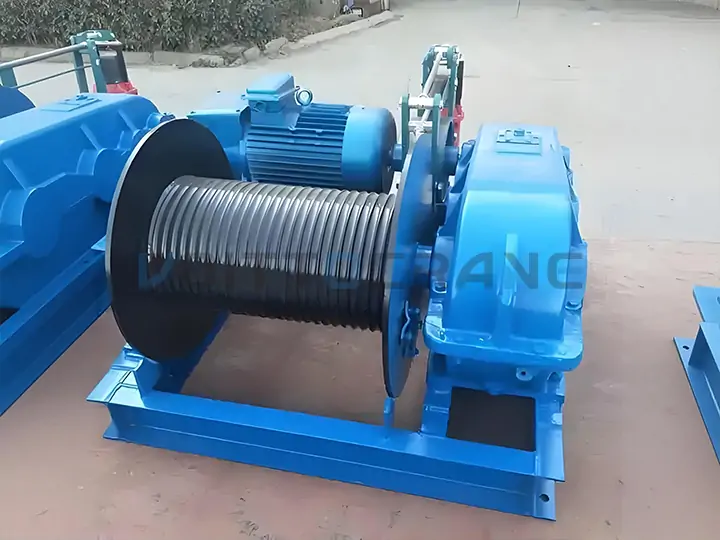
When selecting a winch, the first factor users must determine is the type of drum. Different drum configurations handle the rope in different ways. If the wrong type is chosen, it will adversely affect pulling capacity, rope service life, and operational control. Next, this article will introduce what a crane winch drum is and the different types available to assist users in selecting the most suitable winch equipment.
How a Winch Drum Works
The drum is mounted on a central shaft driven by a gearbox connected to an electric motor, hydraulic motor, or mechanical motor. As the shaft rotates, the wire rope winds concentrically around the drum body. As the wire rope winds onto the drum, the tensile force (line pull) gradually decreases because each layer of winding increases the effective radius. This is not a defect, but rather a geometric consequence inherent to all drum-based winches.
When the motor stops running, a brake, either built into the drum or mounted externally, secures the load. The wire rope is fixed to the drum at a fixed point called the anchor, while its free end extends to the load.
Main Types of Winch Drum
Winch drum types are primarily classified based on rope handling methods and operational requirements: Capstan drums rely on friction drive and do not store rope, making them suitable for ropes of unlimited length and continuous operation. Short drums feature a compact design and are suitable for short-stroke applications. Long drums reduce multi-layer winding and provide more stable traction during long-distance operations. Split drums enhance safety and rope management by separating the working and dead ends. Dual drums are used for independent control of two ropes, enabling coordinated operations in complex conditions. Below, I will introduce the different types of winch drums.
Capstan Winch Drum
A capstan winch does not store rope on the drum at all. The rope passes around a rotating vertical or horizontal cylinder, using friction to generate a pulling force, then exits freely on the other side. The operator controls tension by adjusting the number of wraps and hand tension on the trailing end.
Since the rope is not permanently wound around the drum, the winch can handle ropes of unlimited length. This makes it ideal for deck operations on ships, arborist rigging, and any application where rope length varies significantly. Hydraulic winches use a hydraulic motor to drive the drum, enabling continuous operation and variable speed control without the limitations imposed by motor heat generation.
Short Drum Winch
A short drum winch has a barrel width significantly narrower than its diameter. It stores a limited length of rope, typically one to three layers, and is used when the working stroke is short, and a compact footprint matters more than rope capacity.
Short drum winches are common in industrial positioning tasks, vehicle recovery in tight configurations, and machinery where the load travels a fixed, short distance. Do not use a short drum winch if your application requires pulling a load across a long horizontal distance.
Long Drum Winch
The drum of a long-drum winch is longer than its diameter, allowing it to accommodate more wire rope with fewer wraps. Fewer wraps mean that a more constant tension can be maintained throughout the entire stroke, as the effective winding radius changes less significantly as the rope accumulates.
Long-drum winches are often the preferred choice when loads need to be moved over long distances, and maintaining a constant tension throughout the entire travel is critical. Long-drum configurations are commonly used in forestry, construction material handling, and cable laying equipment.
Split Drum Winch
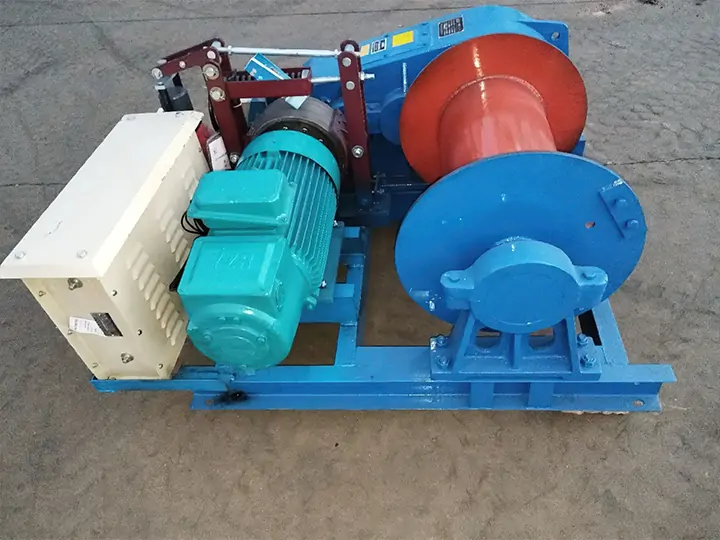
A split-drum winch divides the drum body into two flanged sections separated by a partition. One section is used to wind the working portion of the wire rope, while the other is used to wind the “dead coils”—that is, the minimum number of wire rope layers that must remain on the drum to protect the rope end anchor points from the impact of load stresses.
Maintaining a sufficient number of “dead coils” is a safety requirement for all types of drums. However, due to its unique physical design, the split-drum makes this requirement an absolute necessity. Furthermore, this design allows the wire rope to be wound onto the drum’s storage section under controlled tension, and this process can be performed independently of operations in the working section.
Double Drum Winch
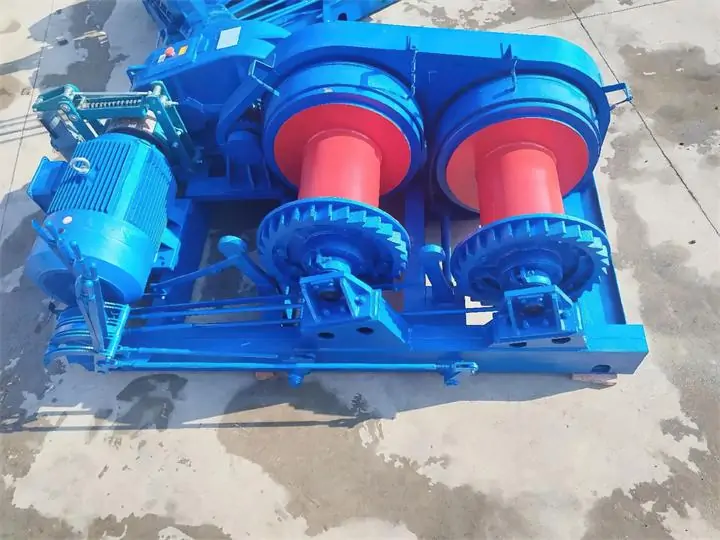
A double drum winch mounts two independent drums on a single shaft or frame, each with its own clutch and brake. This allows two separate ropes to be controlled independently from one power source.
How it works in practice: One drum can pay out while the other retrieves, or both can operate simultaneously at different loads. Double drum winches are used in clamshell bucket operations, dragline excavation, log skidding, and any task requiring coordinated two-line control. The most common misunderstanding is treating a double drum as simply “more capacity”—it is actually a coordination tool, not a capacity multiplier.
Winch Drum Types at a Glance
| Drum Type | Rope Storage | Best Use Case | Common Drive |
|---|---|---|---|
| Capstan | None (pass-through) | Unlimited rope length, marine/arborist | Electric or hydraulic |
| Short drum | Limited (1–3 layers) | Short-stroke industrial/recovery | Electric |
| Long drum | Extended (multiple layers) | Long-distance, consistent pull | Electric or hydraulic |
| Split drum | Two-section barrel | Crane/hoist, formal duty cycling | Hydraulic or electric |
| Double drum | Two independent spools | Two-line coordination | Hydraulic |
How to Attach Winch Rope to Drum?
These ropes are divided into steel wire ropes and synthetic ropes. Below, we will describe the securing methods for each of these two types of rope. The cable or rope must first be secured to an anchor point inside the drum before winding can begin. Most drums have built-in anchor grooves or clamping bolts on the drum body.
Wire Rope
- First, thread the end of the rope through the anchor slot on the outside of the drum, leaving a short length of slack on the inside (about the length of a hand).
- Next, fold this slack back so it lies flat against the main rope, then secure it using the included locking pin or bolt. Never substitute non-original equipment manufacturer (OEM) parts.
- Next, slowly rotate the drum to wind the first few turns of rope while applying light tension. During the initial setup, pull the rope taut by hand to keep it straight as it winds.
- Finally, during use, never allow the rope to completely unwind from the drum. Be sure to always keep at least three full turns of rope on the drum. It is these wound turns of rope that bear the load, not the anchor point.
Synthetic Rope
- The user should thread the end of the rope through the anchor groove or flange opening on the drum.
- The operator should secure it using the knot or locking pin specified by the winch manufacturer. Note: Never tie knots on your own; use only the methods shown in the manual.
- The user should wind the first layer of rope with even tension. A loose first layer will collapse under load and damage the rope.
- Finally, as with steel wire ropes, always maintain at least three turns of rope on the drum during operation.
Considerations for Purchasing a Winch Drum
Users often confuse rated pulling force with continuous working load capacity. The rated pulling force listed in most winch technical specifications typically refers to the force exerted on the first layer of wire rope on the drum (i.e., when the drum is unloaded). If two to three layers of wire rope are wound onto the drum, the actual pulling force may decrease by 20% to 35%. If your application requires a long pulling stroke, be sure to consult the supplier regarding the rated pulling force value for the outermost layer of wire rope.
Users mistakenly believe that hydraulic winches can be used interchangeably with drum-type winches. Hydraulic winches cannot hold a load without continuous hydraulic pressure or an independent braking mechanism. If your application requires not only “pulling” a load but also “hovering” or maintaining the load’s position, be sure to confirm whether the equipment is equipped with a load-holding valve or a mechanical brake.
Users select twin-drum winches to maximize lifting capacity rather than for the purpose of coordinated operation. Each drum on a twin-drum winch has its own independent rated capacity. The capacities of the two drums are not simply additive; therefore, they cannot be used together to lift a single load (unless the equipment is specifically designed as a “tandem lifting system” with a matched rigging configuration).
Conclusion
A crane winch drum is much more than just a simple spool. Its type determines the operating characteristics of the wire rope under load, the drum’s rope capacity, and whether your operation requires single-rope or double-rope control. Before selecting any winch equipment, be sure to confirm its rated pull at the outermost rope position, verify the minimum number of wraps required for the specific rope type, and match the drum configuration to your actual working stroke. Completing these three checks will eliminate the vast majority of operational failures.
As a manufacturer and supplier of crane winch, VOITTO manages every stage of production—from steel plate cutting and gear hobbing to motor winding and final load testing—within its 45,000-square-meter facility. If you require a winch for crane solutions, please feel free to contact us at any time.

Alan
Crane Solutions Specialist · Voitto Crane
Specialized in Overhead Crane, Gantry Crane, Jib Crane, Port Crane & EOT Crane export solutions. 10+ years helping global clients with pre-sales consultation, capacity selection and site-specific configurations.
FAQ
What is a winch drum, in simple terms?
This device features a drum responsible for winding the rope. As the drum rotates, it winds the rope in or pays it out, thereby pulling or releasing the object attached to the rope’s end.
How does a capstan winch work differently from a standard drum winch?
A capstan winch does not wind rope onto the drum permanently. The rope wraps around the spinning drum a few times for friction, then exits freely. This means the operator or a secondary system must manage the trailing rope, but there is no limit on how long that rope can be.
What is the difference between a split drum and a short drum winch?
A split-drum winch divides the drum into two sections: one for winding the working rope and the other for winding the anchor rope. This design is intended to protect the fixed end of the rope under load. In contrast, a short-drum winch simply has a narrower drum. Although it has a smaller rope capacity, there is no physical or mechanical separation between the working rope and the anchor rope.
How often should the rope on a winch drum be inspected?
Inspection frequency depends on usage. A general starting point is to inspect the rope for kinks, broken wires, or flat spots every time it is fully spooled out and retrieved, and to conduct a detailed length inspection at regular service intervals specified by the manufacturer. For specific details regarding the wire rope inspection, please refer to this article: Wire Rope Inspection Guide and Wire Rope Maintenance Field Guide
Does drum type affect which rope I can use?
Yes. Capstan winches typically require synthetic rope or fibre rope with a controlled coefficient of friction. Wire rope is incompatible with most capstan drum designs. Split and long drums are designed for wire rope in most industrial applications, though some are configured for synthetic rope. Always confirm rope compatibility before purchase.



 English
  Español
  Português
  العربية
  Français
  Русский